
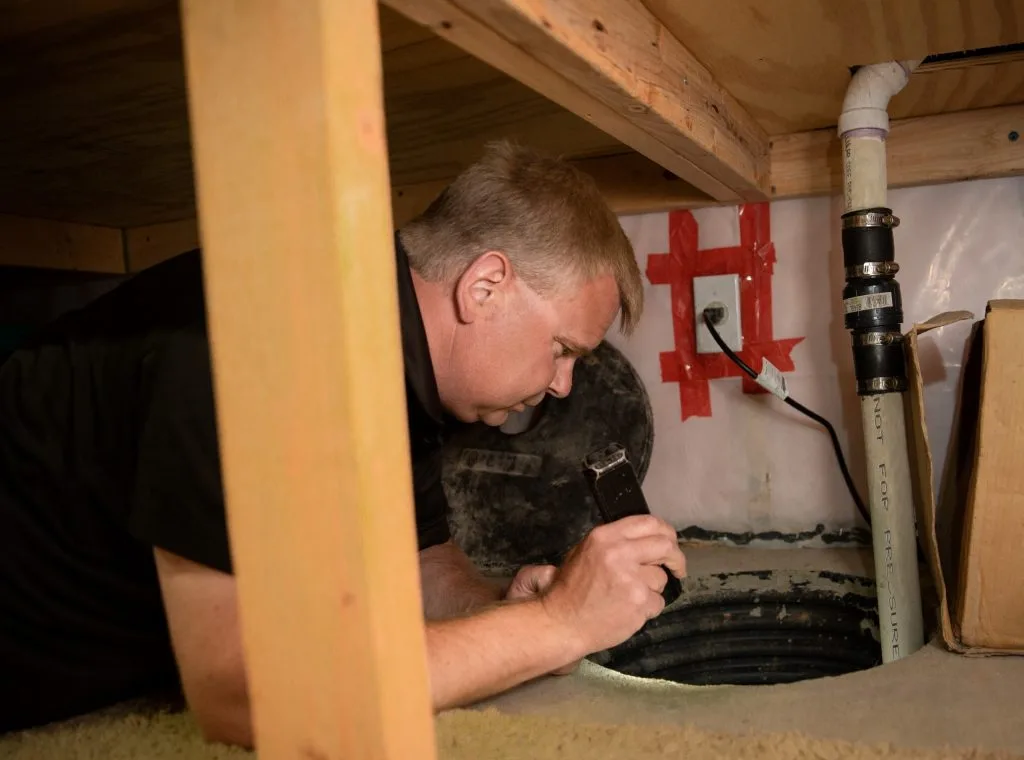
Mold is the one finding that reliably stops a Chicago real estate deal in its tracks — not because it is always serious, but because almost nobody involved can tell whether it is. A gray patch on a basement joist might be five years of harmless surface growth on damp wood, or it might be the visible edge of an active moisture problem behind finished walls. The difference matters, and it is not something you can determine by looking.
Chicago Home Inspect LLC performs mold testing in-house, the same day as your inspection. We are not a referral service and we do not hand you off to a remediation company that profits from finding a problem.
Mold inspection vs. mold testing
These get used interchangeably and they are not the same thing, which is why buyers so often pay for one and expect the other.
A mold inspection is the visual and moisture work — walking the building, reading the staining, running a moisture meter across a suspect wall, finding where water is getting in and what it has been doing. It answers is there a moisture problem, and where.
Mold testing is the sampling — collecting air or material and sending it to a laboratory. It answers what is present, and in what concentration relative to outdoors.
Testing without the inspection produces a number nobody can act on. A lab report saying Aspergillus/Penicillium spores are elevated in a finished basement tells you nothing about whether the cause is a failed downspout, a cracked foundation wall, or a dehumidifier that has been off since April. We do both in the same visit, because the sample is only worth what the inspection makes of it.
The sampling methods we use
We use two sampling methods, and they answer different questions.
Air sampling (spore trap)
A calibrated pump draws a measured volume of air across a collection cassette. We take an outdoor control sample and one or more indoor samples, and an accredited laboratory counts and identifies the spores in each.
The outdoor sample is the part people miss. Mold spores are in outdoor air everywhere, always — a raw indoor spore count means nothing on its own. What matters is the indoor count relative to outdoor, and whether the indoor sample contains genera that should not be growing inside. An indoor count well above the outdoor baseline, dominated by a genus outdoor air does not explain, indicates an interior source.
Surface sampling (tape lift or swab)
When there is visible growth, a surface sample identifies what it is. This answers “what is this black stuff” — useful for scoping remediation, and useful for ruling things out. A surprising amount of what gets called mold in a Chicago basement is efflorescence, mineral salts left behind as water moves through masonry. It wipes off, it is not biological, and it does not need a remediation contractor. It does tell you water is moving through that wall.
Methods we do not offer, and why
We perform air sampling and surface sampling. Those two answer the questions a real estate transaction actually turns on. Three other methods come up in searches, and we would rather tell you plainly that we do not do them than pretend otherwise.
Bulk sampling sends a physical piece of material — drywall, insulation, carpet padding — to the laboratory. It is destructive, it belongs to a remediation scope rather than a pre-purchase inspection, and you are unlikely to get permission to cut into a seller’s wall before closing.
Culture (viable) sampling grows the organism to identify it to species. It takes longer than an attorney review period allows, and it will not count dead spores — which still provoke an allergic response, so a low viable count is not the reassurance it looks like.
ERMI — the Environmental Relative Moldiness Index — analyzes settled dust by DNA sequencing against a panel of 36 species and returns a single index score. It shows up in Chicago searches often enough to be worth addressing directly. The EPA developed ERMI as a research tool and has not validated it for judging an individual home, and no one should be selling it to you as a pass/fail verdict on a house. We do not offer it.
If your situation genuinely calls for one of these, an industrial hygienist is the right professional, and we will say so rather than sell you a sample we do not believe in.
What testing can and cannot tell you
Honest limits, because inspectors who oversell this do real damage:
- There is no federal or Illinois standard for a “safe” indoor mold level. No number exists that anyone can point to and call passing. Interpretation is comparative and contextual — indoor versus outdoor, and what the building conditions support.
- A clean air sample does not prove there is no mold. Growth sealed inside a wall cavity may not release spores into living space until it is disturbed.
- Testing does not find the leak. It tells you spores are elevated. Locating the moisture source is inspection work — moisture meters, thermal imaging, and knowing where Chicago buildings leak.
- Species identification does not establish a health effect for you personally. Sensitivity varies enormously between individuals. That is a conversation for your physician, not your home inspector.
Illinois does not license mold inspectors the way Texas and Florida do. Anyone here can buy a pump and call themselves a mold assessor. That makes it worth asking who is interpreting your results and whether they have any financial interest in the answer.
Why Chicago building stock produces mold
This is not generic advice about humidity. Specific things about how Chicago housing was built and how it ages create predictable moisture problems.
Below-grade living space
Chicago finished more basements than almost any comparable housing stock, and a large share of that work was done without a capillary break, without exterior waterproofing, and often without a permit. Framing and drywall placed directly against a foundation wall that wicks moisture will eventually grow something. Garden units are the most common place we find active growth in the city.
Masonry and failed tuckpointing
Most Chicago two-flats, greystones, and bungalows are solid masonry or masonry veneer. When mortar joints deteriorate, water enters the wall assembly and travels — often appearing on an interior surface several feet from where it got in. Growth on the inside face of an exterior wall usually means the wall is the problem, not the room.
Grading and downspouts
Chicago lots are narrow, and the space between buildings is frequently paved or negatively graded back toward the foundation. Downspouts discharging at the base of a wall — or into a clay tile line that failed decades ago — put roof water directly against the foundation.
Bathroom fans vented into attics
Extremely common in this housing stock. A bath fan discharging into the attic instead of through the roof deposits shower moisture onto cold sheathing all winter. The resulting growth on the underside of the roof deck is one of the most frequent mold findings in Chicago attics, and it has nothing to do with a roof leak.
Freeze-thaw and ice damming
Chicago winters drive water into masonry, freeze it, and open the joint wider each cycle. Ice dams push meltwater back under shingles and into wall cavities at the eaves. Both produce interior moisture that appears in spring and gets blamed on plumbing.
Basement and garden-unit mold inspection
Basements are where most of our sampling happens, and where interpretation matters most. A Chicago basement is a below-grade masonry box surrounded by wet soil. Some level of elevated humidity is normal. What we are looking for is whether the moisture is chronic enough, and the materials organic enough, to support active growth.
Things that change the answer: whether the basement is finished, whether there is a functioning sump and where it discharges, whether the floor drain is connected and trapped, whether joists show historic water staining at the sill, and whether the previous owner’s finish work trapped a wet wall behind studs and drywall. We check all of this as part of the inspection, and it is what turns a spore count into a usable conclusion.
Who regulates mold in Chicago — and who does not
A recurring search is some version of city of Chicago mold inspection, usually from someone hoping a government office will come out and settle the question. It is worth being clear about what exists.
- The city does not perform mold inspections for home buyers. There is no municipal mold inspection you can request as part of a purchase, and no city-issued mold certificate for a property.
- Chicago Department of Public Health work in this area is complaint-driven and aimed at rental housing conditions. If you are a tenant living with an unaddressed leak, that is a habitability complaint and a genuine avenue. If you are a buyer under contract, it is not the process you need.
- Illinois does not license mold inspectors or assessors the way Texas and Florida do. Anyone in this state can buy a pump and call themselves a mold assessor.
- No agency publishes a numerical action level for indoor mold. Not the EPA, not IDPH, not the city. Anyone quoting you a threshold that a house passes or fails is inventing it.
What that adds up to is simple: there is no official body that will hand you an answer before closing. The interpretation is the service, which is why it matters who is doing it and whether they sell remediation.
Multi-unit buildings, condos, and apartments
Two-flats, three-flats, and condo conversions carry a complication: the moisture source is often outside the unit you are buying. A leak in the unit above, a common-wall masonry failure, or a shared roof problem produces growth inside your walls while the cause sits in an area you do not own or control.
For condo buyers this matters for a practical reason — a condo inspection is limited to the unit and does not extend to common elements or association-maintained systems. If sampling indicates a source outside the unit, that becomes an association question and often a document-review question. We will tell you plainly when that is the situation you are in.
When to get a mold inspection
- There is visible growth, staining, or a musty odor anywhere in the building
- The basement or garden unit is finished and you cannot see behind the finishes
- The disclosure mentions past water intrusion, a flooded basement, or a roof or plumbing repair
- The building has been vacant, or heat has been off through a Chicago winter
- Anyone in the household has asthma or significant allergies
- You are buying a flip, where new finishes may be covering unremediated damage
That last one deserves emphasis. Fresh paint and new flooring in a Chicago basement, on a property that turned over quickly, is a reason to sample rather than a reason to relax.
Our process
Mold testing is available as an add-on to your inspection or as a standalone service, and we perform it ourselves — same visit, no second appointment, no third-party referral.
- Visual assessment and moisture mapping. Before any sample is collected, we identify where water is or has been, using moisture meters and the building’s own history.
- Sampling. Outdoor control plus indoor samples placed where the building conditions warrant, not in arbitrary locations.
- Accredited laboratory analysis. Spore counts and genus identification.
Mold inspection and testing cost
Mold testing is priced as an add-on to a home inspection, with laboratory fees included; our current prices list it. For comparison, remediation of a contained basement area generally starts around $2,000 and rises steeply with the affected square footage — which is the actual argument for testing before you close rather than after.
Where we provide mold inspection and testing
We cover Chicago and the north, northwest, and west suburbs — Cook, Lake, McHenry, and DuPage counties — with weekend availability.
Mold inspection and testing is available on every inspection we perform, including Lincoln Park, Lake View, Logan Square, Wicker Park, Jefferson Park, Rogers Park, Evanston, Skokie, Niles, Park Ridge, Des Plaines, Glenview, Arlington Heights, Schaumburg, Mount Prospect, Palatine, Wilmette, Northbrook, Highland Park, Buffalo Grove, Libertyville, Lake Zurich.
Building age and construction type change what we look for. A Lincoln Park greystone with a finished garden unit, a Skokie post-war ranch on a slab, and a Palatine split-level with a below-grade family room each fail in their own characteristic way, and the sampling gets placed accordingly.
Common questions
Can you tell if it is “black mold”?
Stachybotrys chartarum is what people mean, and yes, laboratory analysis identifies it. It requires sustained saturation — not damp, wet — so it usually indicates a long-running leak rather than seasonal humidity. Plenty of dark-colored growth is a different, far more ordinary genus.
Should I test if I do not see anything?
If there is no visible growth, no odor, no moisture history, and no finished below-grade space, testing is usually not the best use of your inspection budget. We will say so.
Do you also do the remediation?
No, deliberately. The company telling you whether you have a problem should not be the company selling the cure.
How fast are results?
Laboratory results are delivered the next business day, which fits comfortably inside a standard Illinois attorney review and inspection period.
Will the City of Chicago inspect my house for mold?
No. There is no city mold inspection available to a buyer, and no municipal mold certificate for a property. City involvement in this area is complaint-driven and concerns rental housing conditions.
Do you offer ERMI testing?
No. The EPA built ERMI as a research tool and has not validated it for judging an individual home, so we do not offer it. For a purchase decision, the air and surface sampling we do perform, paired with a moisture inspection, answers the question better and costs less.
Schedule a Chicago mold inspection
We serve Chicago and the surrounding suburbs, including Cook, Lake, McHenry, and DuPage counties, with weekend availability. If you are under contract and working against an inspection deadline, tell us — we schedule around attorney review timelines routinely.