
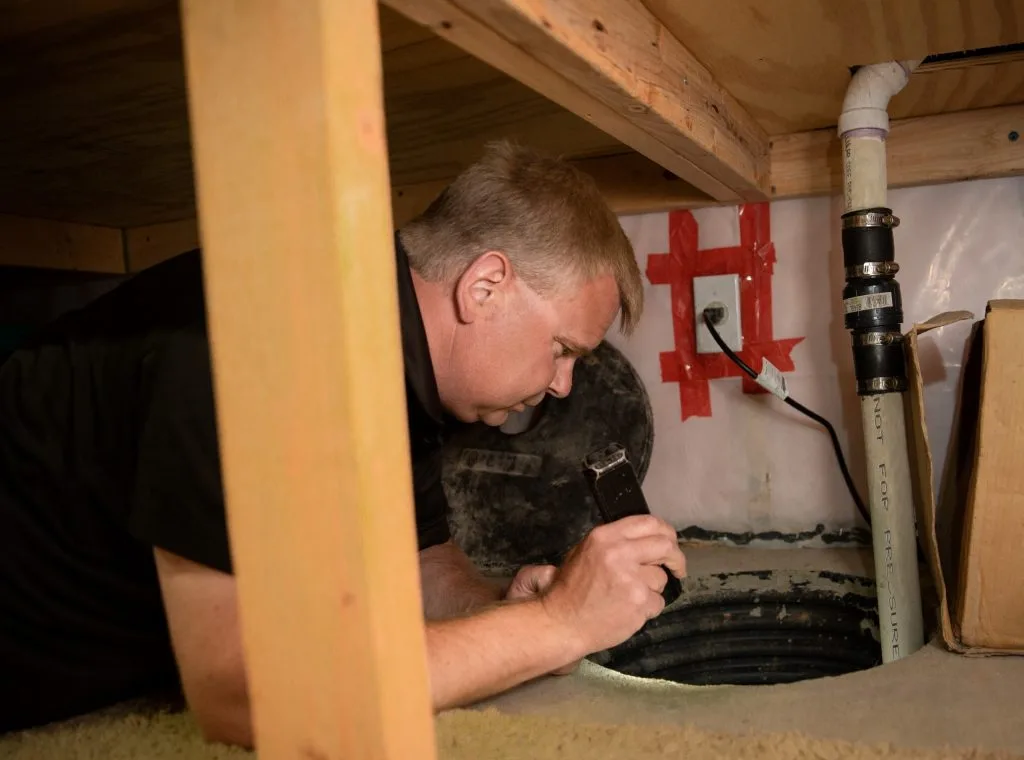
Niles is a village of post-war brick — ranches, raised ranches and split-levels built largely in the 1950s and 60s, with pockets of newer condo and townhome development layered in since. The split-level and raised-ranch configurations are worth calling out on their own, because they concentrate a specific set of problems that a conventional two-story simply does not have.
Book your Niles home inspection — pick a time online in about two minutes. Weekend inspections available.
We are a licensed Illinois home inspection entity (License 451.001520). Every inspection includes thermal imaging at no additional charge, and your full photo report arrives within one business day.
Raised ranches and split-levels have their own failure pattern
These configurations put finished living space partly below grade, put a garage underneath living space, and stack short flights of stairs between levels. Each of those creates issues we look for specifically:
- Below-grade bedrooms without proper egress. A lower-level bedroom needs a window that actually opens to the required size and a well you can climb out of. Undersized wells and painted-shut sashes are common.
- Tuck-under garages. The ceiling between garage and living space has to be fire-separated and the connecting door has to be rated and self-closing. Both get compromised during remodels.
- The lower level is a moisture zone. It is below grade on at least one elevation, and it is finished, so evidence of past water is behind drywall rather than on the wall.
- Combustion air. When the mechanical room gets enclosed to finish the lower level, the furnace and water heater can be left short of the air they need.
Thermal imaging is particularly useful in these houses because so much of the wall area that matters has been finished over.
What is still original from the 1950s and 60s
- Galvanized supply piping, corroding closed from the inside — poor upstairs flow is the tell.
- Cast iron drains, channelling along the bottom where it cannot be seen.
- Federal Pacific Stab-Lok panels, with their documented failure-to-trip history.
- Aluminum branch wiring in anything wired toward the late 1960s, which needs connections rated for it at every device.
- Original brick and mortar that has taken sixty freeze-thaw cycles, especially at chimneys, parapets and the weather elevations.
We photograph data plates so you get real equipment ages rather than an estimate.
Water
Niles is flat and the storm system, like everywhere in this part of Cook County, can surcharge in heavy rain. We check for the signs of a house that has flooded and been fixed — backwater valve, overhead sewer conversion, sump with a working discharge — and for the ordinary causes that account for most wet basements: downspouts discharging at the foundation, grading settled back toward the house, and window wells with nowhere to drain.
Radon and sewer
Radon is common throughout northern Illinois, and the below-grade finished space typical of Niles housing is exactly the configuration worth testing. We are IEMA-licensed and use continuous monitors, not charcoal kits, so you get hourly data rather than one averaged number.
Sewer laterals here are old enough to be clay tile in much of the village, and mature parkway trees have had sixty years to find the joints. A camera scope shows root intrusion, offset joints, bellies and prior liner work — none of which a standard inspection can reach.
Condos and townhomes
For a Niles condo or townhome, the inspection covers the unit and the systems serving it. Roofs, siding, shared risers and common mechanicals are the association’s, and they are also where special assessments come from — so the reserve study and recent meeting minutes deserve real attention. If moisture inside a unit originates in a common element, we will say so, because that determines who pays for it.
Common questions
Is a lower-level bedroom legal?
It depends on egress, ceiling height and how the space was permitted. We report what we can see against the requirements; the village is the authority on what was approved. It matters for resale as much as safety — a bedroom that cannot be advertised as one changes the property.
The house has been in one family since it was built. Is that good or bad?
Usually good for maintenance history and bad for updates. Expect original systems, and expect them to be honest about their age.
Can you inspect on a weekend?
Yes. We do not schedule evenings.
What the inspection does not include
A home inspection is a visual, non-invasive evaluation of the systems accessible on the day of the inspection. We do not open walls, move stored belongings, dismantle equipment, or predict how long a component will last. We do not inspect septic systems or test well water, and we do not perform the structural engineering analysis some findings call for. A sewer scope needs an accessible cleanout; standing water or an inaccessible line limits what the camera can show.
We also do not perform repairs, sell remediation, or take referral fees. We measure and interpret; you decide what to do about it. The company scoping your sewer line should not also be the company quoting the repair.
What the inspection covers: every inspection we perform in Niles follows the same scope. See our home inspection services and what each one covers — pre-purchase, pre-listing, new construction, condo and multi-unit — plus in-house radon, mold, and sewer scope testing.
Nearby areas we inspect: Skokie, Park Ridge, Des Plaines, Glenview. If you are looking in more than one area, the same inspector and the same scope apply to all of them.
Schedule a Niles home inspection
Book your Niles home inspection online. Tell us the address and whether you want radon, mold, or a sewer scope added, and we will confirm the time and what the inspection will cover.