
Schaumburg is a young suburb by Chicago standards. It was farmland into the 1950s and most of what stands here went up between the 1960s and the 1990s, which produces a completely different inspection than a pre-war city building. The problems are not crumbling masonry and knob-and-tube — they are first-generation builder systems reaching the end of their service lives all at once, and a housing stock where a large share of homes are governed by an association.
Book your Schaumburg home inspection — pick a time online in about two minutes. Weekend inspections available.
We are a licensed Illinois home inspection entity (License 451.001520). Every inspection includes thermal imaging at no additional charge, and your full photo report arrives within one business day.
The Schaumburg defect profile is an age cohort, not a style
Houses built in a twenty-year window tend to fail on the same schedule. In Schaumburg that means a recognizable set of findings that have nothing to do with neglect and everything to do with what was standard practice when the subdivision went up:
- Aluminum branch-circuit wiring in homes wired roughly between the mid-1960s and mid-1970s. It is not automatically a hazard, but every connection at every device has to be made with a method rated for aluminum, and it is routinely not.
- Polybutylene supply piping — gray flexible plastic, common from the late 1970s into the 1990s, with a history of failures at the fittings. Insurers ask about it and some decline it.
- Hardboard and composite siding from the 1980s and 90s, which swells and delaminates at the bottom course and behind gutters where it stays wet.
- Original furnaces and air conditioners that are now on their second or third replacement cycle — and in many houses, still on the first.
- Failed insulated-glass seals, visible as permanent fogging between the panes. Cosmetic, but there are often twenty of them and they are quoted per window.
We photograph the data plates, so you get actual ages rather than an inspector guessing at a furnace.
If it is a townhome or condo, the association matters more than the inspection
A large share of Schaumburg housing sits under an association, and that changes what your inspection can and cannot tell you. We inspect the unit and the systems serving it. Roofs, siding, shared plumbing risers, private roadways and common mechanicals are association responsibilities and fall outside a unit inspection — but they are the items most likely to produce a special assessment.
So read the reserve study and two years of meeting minutes with as much attention as you give the inspection report. An association with a twenty-year-old roof and a thin reserve fund is a financial finding the walls will not show you. Where moisture inside a unit originates in a common element, we will say so plainly, because that determines who pays.
Water, on flat ground
Schaumburg sits on heavy clay with very little natural fall. Water does not drain away so much as sit, which puts the load on engineered drainage — sump pumps, drain tile, downspout extensions, and swales between houses that are supposed to carry water to the street.
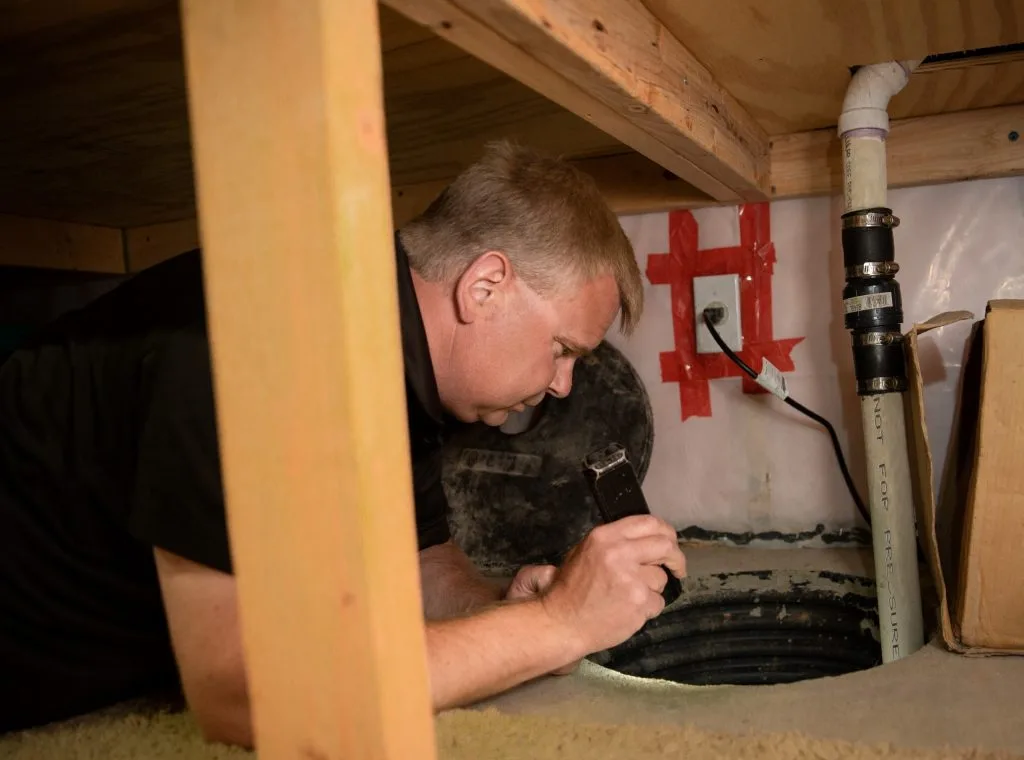
The failures we find are mundane and cheap to fix if you catch them: downspouts discharging two feet from the foundation, a sump discharge that loops back toward the wall, a swale filled in by a previous owner who wanted a flat yard, a sump pump with no battery backup in a house whose basement is finished. We check whether the sump actually cycles, not just whether one is present.
Radon
Northern Illinois sits on glacial till and elevated radon is common across the region. Illinois requires sellers to disclose what they know; it does not require anyone to test, so a blank disclosure means only that nobody has looked. We are IEMA-licensed and test with continuous monitors rather than charcoal kits, which gives you hour-by-hour data instead of one averaged number — the difference matters when a result lands near the 4.0 pCi/L action level and you have to negotiate on it.
Sewer scope
A standard inspection cannot evaluate a buried lateral. Schaumburg lines are generally newer than the clay tile under the older suburbs, which lowers the odds of root intrusion — but mature subdivision trees have had forty years to find a joint, and a camera is the only way to know. We look for root intrusion, offset joints, bellies holding water, and previous liner work.
Common questions
The house is only from the 1980s. Is an inspection really necessary?
A 1980s house is now forty years old. Every mechanical system in it has either been replaced once or is long overdue, and the era has its own specific issues — polybutylene, hardboard siding, aluminum at the older end. Newer than pre-war does not mean fewer findings, it means different ones.
Do you inspect the whole townhome complex?
No — the unit and its systems. Common elements belong to the association. We will tell you when something we can see suggests a common-element problem, but the reserve study is where that question actually gets answered.
Can you inspect on a weekend?
Yes. We do not schedule evenings.
What the inspection does not include
A home inspection is a visual, non-invasive evaluation of the systems accessible on the day of the inspection. We do not open walls, move stored belongings, dismantle equipment, or predict how long a component will last. We do not inspect septic systems or test well water, and we do not perform the structural engineering analysis some findings call for. A sewer scope needs an accessible cleanout; standing water or an inaccessible line limits what the camera can show.
We also do not perform repairs, sell remediation, or take referral fees. We measure and interpret; you decide what to do about it. The company scoping your sewer line should not also be the company quoting the repair.
What the inspection covers: every inspection we perform in Schaumburg follows the same scope. See our home inspection services and what each one covers — pre-purchase, pre-listing, new construction, condo and multi-unit — plus in-house radon, mold, and sewer scope testing.
Nearby areas we inspect: Arlington Heights, Des Plaines, Park Ridge, Palatine. If you are looking in more than one area, the same inspector and the same scope apply to all of them.
Schedule a Schaumburg home inspection
Book your Schaumburg home inspection online. Tell us the address and whether you want radon, mold, or a sewer scope added, and we will confirm the time and what the inspection will cover.