
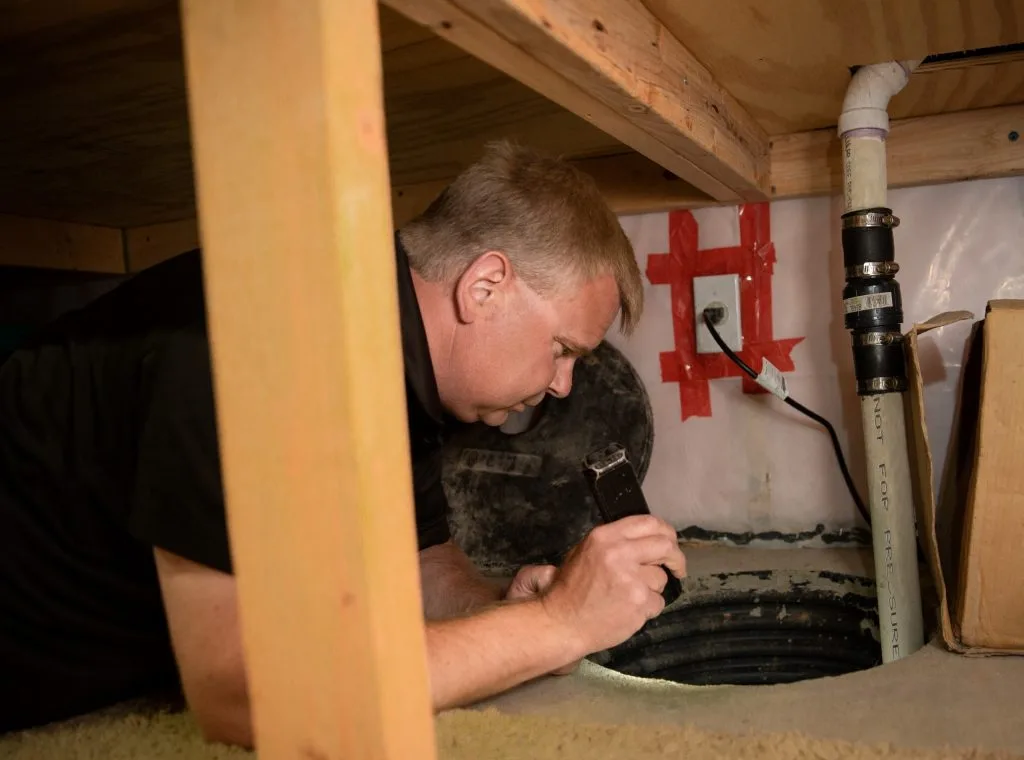
Illinois has some of the highest indoor radon levels in the country, and Chicago-area soil produces elevated readings in housing of every age and price — new construction included. We are licensed by the Illinois Emergency Management Agency and Office of Homeland Security (IEMA-OHS) to perform radon measurement, and we test with continuous monitors rather than mail-in kits.
What Illinois law requires when you buy or sell
This is the part most buyers are never told clearly.
The Illinois Radon Awareness Act (420 ILCS 46), in effect since January 1, 2008, requires the seller of residential real property to give the buyer two things before the buyer becomes contractually obligated to purchase:
- The IEMA-OHS pamphlet Radon Testing Guidelines for Real Estate Transactions
- The Illinois Disclosure of Information on Radon Hazards, stating any radon information the seller knows about
Two things follow from this that buyers routinely get wrong. First, the Act requires disclosure, not testing — a seller who has never tested has nothing to disclose, and that is fully compliant. A blank disclosure is not reassurance. Second, the seller is only obligated to disclose what they actually know. Radon is invisible and odorless, so in most transactions nobody knows anything unless a test is ordered.
If you want to know your radon level before closing, you have to test. Nothing in the transaction produces that number for you.
Illinois also has separate protections for renters under the Illinois Tenants Radon Protection Act, which is worth understanding if you are buying a two-flat or three-flat and intend to rent a unit — you become the party with disclosure obligations.
What radon is and what the numbers mean
Radon is a radioactive gas produced by the decay of uranium in soil and rock. It enters buildings through foundation cracks, control joints, sump pits, floor drains, and gaps around service penetrations, drawn in by the slight negative pressure that heated buildings create in winter. You cannot see, smell, or taste it. It is the second leading cause of lung cancer in the United States after smoking, and the leading cause among people who never smoked.
Measurements are reported in picocuries per liter (pCi/L).
- 4.0 pCi/L — the EPA action level. At or above this, mitigation is recommended.
- 2.0 to 3.9 pCi/L — below the action level, but the EPA notes there is no threshold below which radon is known to be harmless. Many homeowners choose to mitigate in this range, and mitigation is inexpensive enough that it is a reasonable choice.
- Below 2.0 pCi/L — generally considered acceptable. Retest every two years.
There is no radon level that makes a house unbuyable. Mitigation systems work, they are well understood, and they typically cost far less than buyers expect. A high reading is a negotiation item, not a reason to walk.
Why Chicago-area homes test high
Northern Illinois sits on glacial till — dense, clay-rich soil deposited by retreating glaciers, containing uranium-bearing rock fragments. Several counties in the Chicago metropolitan area, including collar counties such as Kane and McHenry, carry the EPA’s highest radon zone designation, and elevated results are common throughout the region.
Local building practice compounds it:
- Deep basements. Chicago builds below grade almost universally, which puts occupied space in direct contact with soil gas.
- Finished basements and garden units. Converting below-grade space into bedrooms and offices means people now spend sleeping hours in the highest-concentration part of the building.
- Open sump pits. An uncovered sump is a direct pathway from soil to living space, and it is standard in this housing stock.
- Stack effect. Tall, narrow Chicago buildings heated through a long winter generate strong negative pressure at the lowest level, actively drawing soil gas in.
We have measured elevated levels in new construction and in century-old greystones on the same street. Age, price, and neighborhood predict very little. The only thing that tells you a specific home’s level is testing that specific home.
How we test
We use EPA-approved continuous radon monitors, not charcoal canisters. The distinction matters more than it sounds.
A charcoal kit returns one averaged number. A continuous monitor records hour by hour, which means the report shows the level and the shape of the test — whether readings were stable, and whether conditions were disturbed. If a window was opened partway through a real estate test, a continuous monitor shows it. A charcoal kit silently averages it in and returns a falsely low result. In a transaction where the number drives a negotiation, that difference is the whole point.
Closed-house conditions
Short-term testing requires closed-house conditions, and the result is only valid if they are maintained:
- Windows and exterior doors closed for 12 hours before the test begins and throughout it
- Normal entry and exit is fine — doors should not be propped open
- Heating and air conditioning operate normally; whole-house fans and window fans stay off
- Minimum test duration of 48 hours
The monitor is placed in the lowest level suitable for occupancy, away from exterior walls, drafts, and sump pits, at normal breathing height. Placement is not arbitrary and it changes the result — it is one of the more common reasons DIY kits produce numbers nobody can act on.
Results
You receive your report the same business day the monitor is retrieved, showing the hourly data, the test average, the conditions during the test, and a plain-language interpretation. The documentation format is accepted by lenders, agents, and attorneys, which matters when the result becomes part of an inspection response.
If your result is elevated
The standard fix is active soil depressurization — a sealed suction point in the basement slab or sump, a sealed pipe routed above the roofline, and a continuously running inline fan that keeps soil gas below the slab and vents it outside. It is quiet, uses little electricity, and typically reduces levels by 80–99%.
Installed cost in the Chicago area generally runs $1,200–$2,500 depending on foundation type, routing, and whether the building is a single-family home or a multi-unit. In a transaction this is normally negotiated as a seller credit or a seller-completed repair.
We do not install mitigation systems. We measure, we interpret, and we can point you toward licensed mitigation professionals — but the party telling you whether you have a problem should not be the party selling the solution.
Always retest after mitigation. A system that was installed but never verified is an assumption, not a result. We perform post-mitigation testing regularly, and we do occasionally find systems that are not achieving what they should.
When to test
- Before closing on any Illinois home. The disclosure will usually be blank; that is not information.
- Every two years thereafter, per EPA guidance. Levels are not static.
- Before finishing a basement or converting below-grade space to a bedroom or office — before you spend the money, not after.
- After foundation work, underpinning, or significant structural repair, which can open new soil-gas pathways.
- After installing or servicing a mitigation system.
- If your last test was during a purchase years ago. That number describes a house that has since had new windows, a new furnace, and a different pressure profile.
Common questions
Is radon common in Chicago?
Yes. Elevated results are common throughout northern Illinois, and several counties in the metropolitan area carry the EPA’s highest radon zone designation. It is common enough that we consider testing standard for any home with occupied below-grade space.
Are the free county test kits good enough?
For general awareness, they are genuinely useful and worth using. For a real estate transaction they are not — they are charcoal kits, results are unverifiable, placement and closed-house conditions are unwitnessed, and the other side of a negotiation has every reason to challenge them.
My neighbor tested low. Does that cover me?
No. Adjacent homes on identical soil routinely differ by several pCi/L, because the result depends on that building’s foundation, pressure behavior, and pathways rather than on the block.
Can radon be tested alongside the home inspection?
Yes, and that is how most of our clients do it. The monitor is placed at the inspection and retrieved 48 hours later, which fits inside a normal Illinois attorney review period.
Does a mitigation system hurt resale?
The opposite, generally. A documented system with a post-mitigation test is a resolved issue with paperwork. An untested house is an open question.
Schedule radon testing
Radon testing is available as a standalone service or alongside a home inspection, throughout Chicago and the surrounding suburbs including Cook, Lake, McHenry, and DuPage counties, with weekend availability. If you are working against an attorney review deadline, tell us when you book — we schedule around inspection contingency periods routinely.