
Mount Prospect is a post-war village of brick ranches, split-levels and Georgians, built largely through the 1950s and 60s, with newer condos and townhomes near the Metra station and along the commercial corridors. It sits close enough to O’Hare that the airport has left a physical mark on the housing, and flat enough that drainage is a recurring theme.
Book your Mount Prospect home inspection — pick a time online in about two minutes. Weekend inspections available.
We are a licensed Illinois home inspection entity (License 451.001520). Every inspection includes thermal imaging at no additional charge, and your full photo report arrives within one business day.
What is still original
- Galvanized supply piping, corroding closed from the inside — weak flow upstairs while the basement runs fine is the classic sign.
- Cast iron drain stacks, channelling along the bottom of the pipe where nobody can see it.
- Federal Pacific Stab-Lok panels, with a documented history of breakers failing to trip.
- Ungrounded receptacles — and, more misleading, three-prong outlets swapped in over two-wire cable, which look grounded and are not. We test rather than assume.
- Original furnaces and water heaters in houses that have had one owner for decades.
The O’Hare sound insulation program
Homes in the areas affected by aircraft noise were eligible for the airport’s residential sound insulation program, which installed replacement windows and in many cases added central air conditioning. If the windows and the AC are conspicuously newer than the rest of the house, that is usually why. It is worth establishing which components came from the program and which are original, because it changes the remaining-life picture on two of the more expensive systems in the building.
Water and drainage
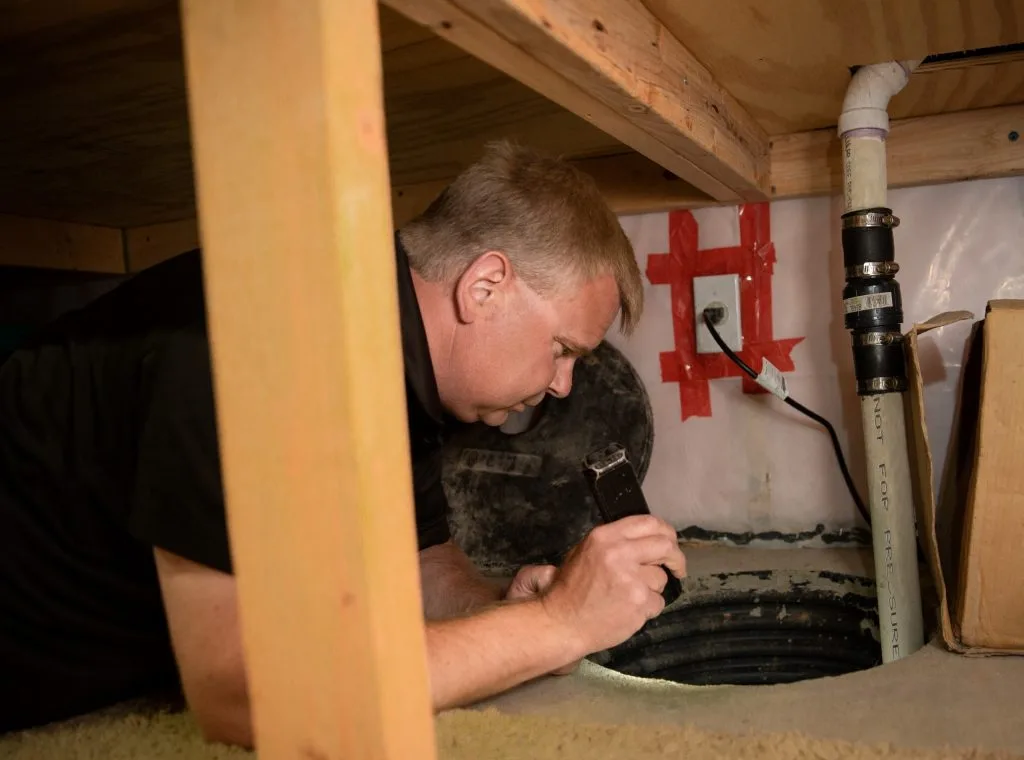
The village is flat and parts of it drain toward creeks that have backed up in heavy rain. We look for the evidence of a house that flooded and was fixed — an overhead sewer conversion or a backwater valve, whether that valve is accessible for the servicing it needs, whether the ejector pit is sealed and vented, whether the sump cycles and where it discharges. Then the ordinary causes, which account for most wet basements: downspouts at the foundation, grading settled back over sixty years, window wells with nowhere to drain.
Additions and finished basements
Decades of families growing into modest ranches produce additions, dormers and finished lower levels of widely varying quality. We look for bearing walls opened without a beam sized for the load, bathrooms added over notched joists, and the safety items that matter once a basement is finished: bedroom egress, combustion air for the furnace and water heater after the mechanical room gets enclosed, and smoke and CO placement on the added level. Thermal imaging shows skipped insulation and damp walls behind new drywall without opening anything.
Radon and sewer
Radon is common across northern Illinois — this is glacial till, and elevated readings are ordinary rather than exotic. Illinois requires sellers to disclose what they know but does not require anyone to test, so a blank disclosure means only that nobody has looked. We are IEMA-licensed and test with continuous monitors rather than charcoal kits, which gives you hour-by-hour data instead of one averaged number — the difference matters when a result lands near the 4.0 pCi/L action level and you have to negotiate on it.
Sewer laterals in this housing stock are frequently clay tile, and the parkway trees that shade these streets have had sixty years to find the joints. A camera scope shows root intrusion, offset joints, bellies holding water and prior liner work — none of which a standard inspection can reach.
Common questions
The windows and AC look newer than everything else. Is that a red flag?
Usually the opposite — it is often the sound insulation program, and it means two expensive systems are younger than the house. Worth confirming which items were included.
Can you inspect on a weekend?
Yes. We do not schedule evenings.
What the inspection does not include
A home inspection is a visual, non-invasive evaluation of the systems accessible on the day of the inspection. We do not open walls, move stored belongings, dismantle equipment, or predict how long a component will last. We do not inspect septic systems or test well water. We also do not perform the structural engineering analysis some findings call for. A sewer scope needs an accessible cleanout; standing water or an inaccessible line limits what the camera can show.
We do not perform repairs, sell remediation, or take referral fees. We measure and interpret; you decide what to do about it.
What the inspection covers: every inspection we perform in Mount Prospect follows the same scope. See our home inspection services and what each one covers — pre-purchase, pre-listing, new construction, condo and multi-unit — plus in-house radon, mold, and sewer scope testing.
Nearby areas we inspect: Arlington Heights, Des Plaines, Palatine, Park Ridge. If you are looking in more than one area, the same inspector and the same scope apply to all of them.
Schedule a Mount Prospect home inspection
Book your Mount Prospect home inspection online. Tell us the address and whether you want radon, mold, or a sewer scope added, and we will confirm the time and what the inspection will cover.