
Des Plaines is a city of mid-century houses on a river that floods. Those two facts drive most of what an inspection here actually turns up. Whether you are buying a 1950s brick ranch off Golf Road, a raised ranch on the west side, or a newer townhome near downtown, the questions worth answering are largely the same: where does water go, what is the original mechanical equipment still doing, and what has been changed without a permit.
Book your Des Plaines home inspection — pick a time online in about two minutes. Weekend inspections available.
We are a licensed Illinois home inspection entity (License 451.001520). Every inspection includes thermal imaging at no additional charge, and your full photo report arrives within one business day.
Water is the Des Plaines question
The Des Plaines River runs the length of the city, and the flood history is not academic — large parts of Des Plaines have flooded repeatedly, and the city has spent decades on levees, reservoirs, and buyouts of the worst-hit properties. That history shapes what you should be asking about any house here, including ones well away from the floodplain.
Riverine flooding is only one of three separate ways water gets into a Des Plaines basement, and they have different fixes:
- Overland flooding from the river or a swollen creek. This is what flood insurance and the FEMA maps address. Your lender will tell you if the property is in a mapped zone, but a house just outside a mapped zone is not therefore dry.
- Sewer backup, when the combined or sanitary system surcharges in heavy rain and comes up through the lowest fixture — the basement floor drain, a shower, a laundry tub. This is the one that ruins finished basements, and it is not covered by standard homeowner policies without an endorsement.
- Groundwater and surface water — saturated soil against the foundation, downspouts discharging at the wall, grading that has settled back toward the house over sixty years. The most common of the three and the cheapest to correct.
Overhead sewers, backwater valves, and what they tell you
Many Des Plaines homes have been converted to an overhead sewer, or have had a backwater valve installed, specifically because the house backed up at some point. Finding one is useful information in both directions: it means somebody spent real money solving a real problem, and it means the problem existed.
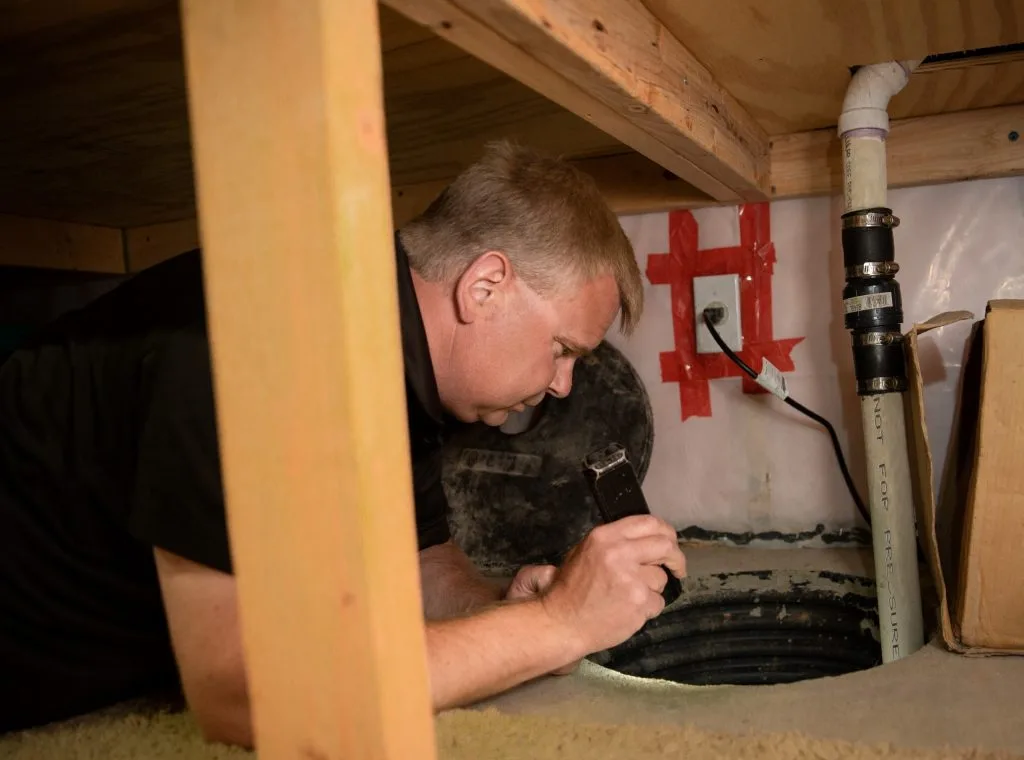
We document which system is present, whether the ejector pit is sealed and vented, whether the backwater valve is accessible for the servicing it requires, and whether the sump discharge actually carries water away from the foundation rather than looping back to the wall. A backwater valve nobody can reach is a valve nobody is maintaining.
What mid-century Des Plaines housing stock tends to hide
Electrical
Houses built through the 1950s, 60s and 70s carry a recognizable set of issues. Federal Pacific Stab-Lok panels show up regularly and have a documented history of breakers failing to trip. Aluminum branch-circuit wiring appears in homes wired in the mid-1960s to mid-1970s and requires specific connection methods at every device. Ungrounded receptacles are common in the oldest sections, as are three-prong outlets someone swapped in over two-wire cable, which looks grounded and is not.
We test receptacles for grounding and correct polarity, check GFCI and AFCI protection where it is required, open the panel, and photograph what is actually inside it.
Plumbing
Galvanized steel supply piping corrodes from the inside and shows up as poor flow long before it leaks. Cast iron drain stacks channel and split along the bottom of the pipe where you cannot see it. Both are original equipment in a great many Des Plaines houses, and both are ordinary end-of-life findings rather than emergencies — but they belong in your budget, not in a surprise.
Heating, cooling, and the O’Hare sound insulation program
Des Plaines sits under O’Hare’s flight paths, and homes in the affected areas were eligible for the airport’s residential sound insulation program, which installed replacement windows and, in many cases, central air conditioning. If you are looking at a house with newer windows and an air conditioner that does not match the age of the furnace, that is often the explanation. It is worth knowing which components were replaced under the program and which are still original, because it changes the remaining-life picture considerably.
Radon
Northern Illinois sits on glacial till, and elevated radon is common throughout Cook County — this is not a rare finding here. Illinois law requires sellers to disclose what they know about radon, but it does not require anyone to test, so a blank disclosure tells you nothing except that no one has looked.
We are IEMA-licensed and test with continuous monitors rather than charcoal kits, which means you get hour-by-hour data instead of a single averaged number — useful if a result lands near the 4.0 pCi/L action level and you need to negotiate. Houses with sump pits, unsealed crawlspaces, or finished below-grade living space are the ones most worth testing.
Sewer scope
A standard home inspection cannot evaluate a buried lateral. In housing stock this age, the lateral is often clay tile or cast iron, and the parkway trees that make these streets pleasant are the same trees whose roots find the joints. A camera scope shows root intrusion, offset joints, bellies holding water, channelling in cast iron, and prior liner work. Given how much of Des Plaines has a sewer-backup history, this is the add-on we recommend most often here.
Mold and moisture
We do mold testing in-house, including air sampling with an outdoor control. Below-grade finished space is the usual concern in Des Plaines, along with bath fans vented into attics rather than outdoors. Worth knowing: there is no federal or Illinois “safe” numerical level for mold, Illinois does not license mold assessors, and a clean air sample does not prove a house has no mold. Anyone telling you otherwise is overselling the test.
Condos, townhomes, and two-flats
For a condo or townhome, the inspection covers the unit and its systems. Roofs, siding, common plumbing risers, and shared mechanicals are association responsibilities and fall outside the scope of a unit inspection — but they still affect you, so the reserve study and the association’s meeting minutes are worth as much of your attention as the inspection report. If the moisture in a unit originates in a common element, we will say so.
What the inspection does not include
A home inspection is a visual, non-invasive evaluation of accessible systems on the day of the inspection. We do not open walls, move stored belongings, dismantle equipment, or predict how long something will last. We do not inspect septic systems or test well water. We do not evaluate seawalls, docks, or structural engineering questions that call for a licensed engineer. And a sewer scope needs an accessible cleanout — standing water or an inaccessible line limits what the camera can show.
We also do not perform repairs, sell remediation, or take referral fees from contractors. We measure and interpret; you decide what to do about it. The company scoping your sewer line should not also be the company quoting the repair.
Common questions
Should I test for radon if the neighbor tested low?
Yes. Radon entry depends on the individual house — its foundation, its sump pit, its air pressure relationship with the soil. Two houses on the same block routinely test differently.
The basement looks dry. Do I still need to worry about water?
A dry basement in a dry month proves less than people assume. We look for the evidence that outlasts the water — staining at the base of the walls, efflorescence, rusted mechanical feet, replaced bottom plates on finished walls, a floor drain with a fresh backwater valve. The house usually tells you what has happened to it.
Can you inspect on a weekend?
Yes, we do weekend inspections. We do not schedule evenings.
How soon do I get the report?
Within one business day — a full photo report with plain-English findings and a clear summary, in time to be useful during your attorney review and inspection period.
What the inspection covers: every inspection we perform in Des Plaines follows the same scope. See our home inspection services and what each one covers — pre-purchase, pre-listing, new construction, condo and multi-unit — plus in-house radon, mold, and sewer scope testing.
Nearby areas we inspect: Park Ridge, Niles, Glenview, Arlington Heights, Mount Prospect. If you are looking in more than one area, the same inspector and the same scope apply to all of them.
Schedule a Des Plaines home inspection
Book your Des Plaines home inspection online. Tell us the address and whether you want radon, mold, or a sewer scope added, and we will confirm the time and what the inspection will cover.