
Arlington Heights is really three housing markets in one village. There is the older stock around the downtown and the Metra station, much of it pre-war. There are the large subdivisions that went up through the 1960s, 70s and 80s. And there is a growing set of downtown condos and townhomes built for people who wanted to walk to the train. Each carries a different inspection, and knowing which one you are buying changes what matters.
Book your Arlington Heights home inspection — pick a time online in about two minutes. Weekend inspections available.
We are a licensed Illinois home inspection entity (License 451.001520). Every inspection includes thermal imaging at no additional charge, and your full photo report arrives within one business day.
Older stock near downtown
The pre-war and immediately post-war houses closer to the center of the village behave like city housing. Expect plaster over lath, solid or veneer masonry with sixty to a hundred freeze-thaw cycles behind it, galvanized supply piping, cast iron drains, and the possibility of knob-and-tube surviving in an attic that was never renovated. Additions and dormers are common and their quality varies; we look at how the framing was actually carried, not just whether the room looks finished.
The subdivision cohort
The 1960s–80s subdivisions produce a consistent age-cohort profile — problems that come from what was standard at the time rather than from neglect:
- Aluminum branch-circuit wiring in the mid-1960s to mid-1970s homes, which needs connections rated for aluminum at every device and routinely does not have them.
- Polybutylene supply piping in the later end of the range, with its fitting-failure history and the insurance questions that follow it.
- Hardboard and composite siding swelling at the bottom course and behind gutters.
- Cedar shake roofs, which look characterful and are expensive to do properly when they go.
- Original mechanicals — we photograph data plates so you get real ages, not estimates.
Downtown condos and townhomes
For a condo or townhome the inspection covers your unit and the systems serving it. The building envelope, the roof, shared risers, elevators and garage structure are association responsibility — and in a mixed-use or podium building those are the genuinely expensive items. Read the reserve study and two years of minutes. A healthy-looking unit in an association with a thin reserve is a financial problem the finishes will not show.
Water and drainage
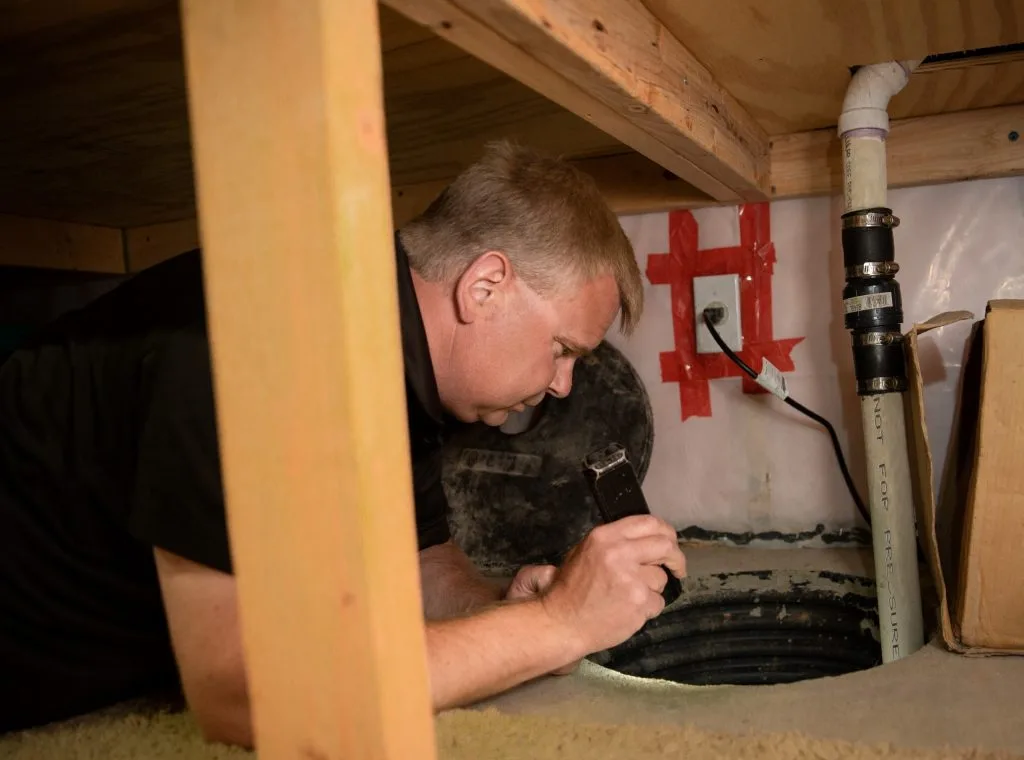
Parts of the village drain toward creeks that have flooded, and the flatter subdivisions rely on engineered drainage rather than natural fall — sump pumps, drain tile, downspout extensions and swales between houses. The failures are usually simple: a swale filled in for a flat lawn, downspouts ending at the foundation, a sump discharge looping back to the wall, or no battery backup on a pump serving a finished basement. We check that the sump actually cycles.
Radon and sewer
Radon is common across northern Illinois and worth testing in any house with a sump pit or finished lower level. We are IEMA-licensed and use continuous monitors rather than charcoal kits, so you get hourly data instead of a single averaged number. For the older sections near downtown, clay tile laterals and mature parkway trees make a sewer scope a genuinely useful spend; in the newer subdivisions the lines are younger but the trees have still had forty years to work on the joints.
Common questions
How do I tell which of the three markets my house is in?
Build year does most of the work, and we confirm it against what the house actually shows. It matters because it changes the whole finding profile — a 1925 house near the station and a 1978 house in a subdivision have almost nothing in common except the village.
Is aluminum wiring a dealbreaker?
No, but it is a real repair with a real cost, and it is an insurance question as well as a safety one. Get the scope of remediation priced before you finish negotiating.
Can you inspect on a weekend?
Yes. We do not schedule evenings.
What the inspection does not include
A home inspection is a visual, non-invasive evaluation of the systems accessible on the day of the inspection. We do not open walls, move stored belongings, dismantle equipment, or predict how long a component will last. We do not inspect septic systems or test well water, and we do not perform the structural engineering analysis some findings call for. A sewer scope needs an accessible cleanout; standing water or an inaccessible line limits what the camera can show.
We also do not perform repairs, sell remediation, or take referral fees. We measure and interpret; you decide what to do about it. The company scoping your sewer line should not also be the company quoting the repair.
What the inspection covers: every inspection we perform in Arlington Heights follows the same scope. See our home inspection services and what each one covers — pre-purchase, pre-listing, new construction, condo and multi-unit — plus in-house radon, mold, and sewer scope testing.
Nearby areas we inspect: Des Plaines, Schaumburg, Park Ridge, Palatine, Mount Prospect, Buffalo Grove. If you are looking in more than one area, the same inspector and the same scope apply to all of them.
Schedule a Arlington Heights home inspection
Book your Arlington Heights home inspection online. Tell us the address and whether you want radon, mold, or a sewer scope added, and we will confirm the time and what the inspection will cover.