
Nearly half of your annual energy bill goes toward heating and cooling, according to ENERGY STAR. For Chicago homeowners facing sweltering summers and icy winters, that can add up fast. Smart thermostats promise to change the game by learning your schedule, fine-tuning comfort, and delivering savings you can feel. If you have heard rumors that these devices are just for tech wizards or cost too much, it is time to clear the air and unlock the real benefits.
Table of Contents
- Defining Smart Thermostats And Common Myths
- How Smart Thermostats Operate In Homes
- Types Of Smart Thermostats And Key Features
- Potential For Utility Bill Savings Explained
- Comparing Smart Thermostats With Traditional Models
- Practical Considerations For Chicago Area Homes
Key Takeaways
| Point | Details |
|---|---|
| Smart Thermostats Offer Advanced Features | They learn user preferences, enable remote management, and optimize HVAC efficiency, representing a significant upgrade over traditional models. |
| Myths Can Hinder Adoption | Common misconceptions regarding complexity and cost may prevent homeowners from leveraging the energy savings and comfort benefits of smart thermostats. |
| Significant Utility Bill Savings | Smart thermostats can reduce energy bills significantly, by automating temperature adjustments based on occupancy and local weather conditions. |
| Climate-Specific Considerations | In climates like Chicago, it’s vital to choose smart thermostats that are compatible with existing HVAC systems and capable of handling extreme temperature fluctuations. |
Defining Smart Thermostats and Common Myths
Smart thermostats represent a significant technological leap in home climate control, transforming how Chicago homeowners manage their indoor temperatures. Smart thermostats are advanced Wi-Fi-enabled devices that go far beyond traditional temperature regulation. According to Energy Star, these intelligent devices can automatically adjust heating and cooling settings for optimal performance while allowing remote control via smartphones and learning your unique household preferences.
At their core, smart thermostats offer three revolutionary capabilities that set them apart from traditional models. As BASC explains, these devices provide advanced control by:
- Learning occupant schedules and predicting temperature needs
- Adjusting temperatures automatically for maximum comfort and efficiency
- Enabling remote management through mobile devices
Common myths about smart thermostats often prevent homeowners from experiencing their full benefits. Many Chicago residents mistakenly believe these devices are complicated, expensive, or only suitable for tech-savvy households. In reality, most smart thermostats are designed with user-friendly interfaces and can be easily installed by homeowners with basic technical skills. They typically pay for themselves through energy savings within just a few years, making them a smart investment for budget-conscious homeowners in neighborhoods from Lincoln Park to Evanston.
While the technology might seem complex, smart thermostats are essentially intelligent learning systems that continuously optimize your home’s climate. They track your temperature preferences, monitor your daily routines, and make automatic adjustments that can significantly reduce energy consumption. For Chicago homeowners dealing with extreme temperature variations, these devices can mean substantial savings on heating and cooling costs while maintaining perfect home comfort.
How Smart Thermostats Operate in Homes
Smart thermostats represent a sophisticated blend of advanced sensor technology and intelligent software design, transforming how Chicago homes manage indoor climate control. According to IEA-4E, these devices optimize HVAC control by utilizing local weather data and wireless sensors to monitor critical environmental conditions like temperature, humidity, and home occupancy.
The core operating mechanism of smart thermostats involves multiple interconnected technologies:
- Sensor networks that detect room temperatures and human presence
- Machine learning algorithms that understand household temperature preferences
- Wireless connectivity enabling remote monitoring and control
- Weather integration to predict and adjust heating and cooling needs
As MEP Academy explains, these devices function by comprehensively learning user schedules and detecting occupancy patterns. In practical terms for a Chicago home, this means your thermostat can automatically adjust temperatures based on whether you’re at work, sleeping, or enjoying a weekend at home. The system gradually builds a profile of your comfort preferences, making micro-adjustments that optimize both energy efficiency and personal comfort.
For Chicagoland homeowners, smart thermostats offer a revolutionary approach to home climate management. By continuously analyzing data from multiple sources – your daily routines, local weather conditions, and real-time home occupancy – these intelligent systems can dramatically reduce energy waste. They don’t just react to temperature changes; they anticipate and proactively manage your home’s heating and cooling needs, potentially saving homeowners significant money on utility bills while maintaining an ideal indoor environment.
Types of Smart Thermostats and Key Features
Smart thermostats have evolved into sophisticated home climate management systems with diverse capabilities tailored to different household needs. ENERGY STAR highlights that certified smart thermostats now offer advanced features designed to optimize energy efficiency and user convenience, transforming how Chicago homeowners control their indoor environments.
These devices typically fall into three primary categories:
- Learning Thermostats: Automatically adapt to household patterns
- Programmable Thermostats: Allow precise scheduling of temperature changes
- Geofencing Thermostats: Adjust settings based on occupants’ physical location
As Wikipedia explains, smart thermostats come equipped with a range of innovative features. Key capabilities include programmable schedules, machine learning auto-scheduling, occupancy sensors, and seamless remote control through internet-connected devices. For Chicagoland homeowners, this means unprecedented control over home climate – whether you’re managing temperatures from your office in the Loop or adjusting settings while traveling through O’Hare Airport.
The most advanced smart thermostats integrate multiple technologies to deliver exceptional performance. They combine precise temperature monitoring, predictive algorithms, and energy-saving protocols to create a truly intelligent home climate management system. By analyzing your specific household patterns, tracking local weather conditions, and providing granular control, these devices do more than just regulate temperature – they create personalized comfort experiences while helping homeowners significantly reduce energy consumption and utility costs.
Potential for Utility Bill Savings Explained
Understanding the financial benefits of smart thermostats begins with recognizing how much energy heating and cooling consume in the average home. ENERGY STAR reveals that nearly half of a typical household’s annual energy bill is attributed to heating and cooling expenses. This significant percentage represents an enormous opportunity for potential savings through intelligent temperature management.
The potential savings from smart thermostats can be substantial and multi-faceted:
- Automated Energy Optimization: Reducing unnecessary heating and cooling
- Precise Temperature Control: Minimizing energy waste through intelligent scheduling
- Behavioral Insights: Providing data to help homeowners make more efficient choices
- Remote Management: Enabling instant adjustments to prevent unnecessary energy consumption
According to IEA-4E, smart thermostats can dramatically reduce energy consumption by automating HVAC operations based on occupancy and weather conditions. For Chicago homeowners battling extreme temperature variations, this means potentially saving hundreds of dollars annually. The system learns your specific household patterns, automatically adjusting temperatures when you’re away or asleep, eliminating the energy drain of maintaining unnecessary heating or cooling.
While the initial investment in a smart thermostat might seem significant, the long-term financial benefits are compelling. Most Chicago homeowners can expect to recoup their initial costs within 2-3 years through reduced utility bills. Moreover, these devices provide granular insights into your energy consumption, empowering you to make more informed decisions about your home’s climate management. By transforming how you interact with your home’s heating and cooling systems, smart thermostats offer not just savings, but a more intelligent approach to residential energy use.
Comparing Smart Thermostats With Traditional Models
The evolution of home temperature control represents a remarkable technological leap, transforming how Chicago homeowners manage their indoor climate. According to BASC, smart thermostats fundamentally differ from traditional models by offering advanced features like learning user schedules, enabling remote control, and seamlessly integrating with home automation systems.
Key differences between traditional and smart thermostats include:
- Programming Complexity: Traditional models require manual, time-consuming adjustments
- Energy Efficiency: Smart thermostats automatically optimize temperature settings
- Connectivity: Traditional thermostats operate in isolation; smart versions connect to home networks
- Learning Capabilities: Smart thermostats adapt to household patterns, traditional models do not
Wikipedia highlights that smart thermostats improve upon traditional models through Wi-Fi connectivity, sophisticated learning algorithms, and comprehensive remote access. For Chicagoland homeowners dealing with dramatic seasonal temperature shifts, this means unprecedented control. While a traditional thermostat might require you to manually adjust settings when leaving home or returning, a smart thermostat anticipates your needs, automatically managing temperatures to maximize comfort and energy efficiency.
The technological gulf between traditional and smart thermostats extends beyond simple temperature control. Smart thermostats provide detailed energy consumption reports, allow precision scheduling, and can even integrate with other smart home devices. They transform your heating and cooling system from a basic utility into an intelligent, responsive home management tool. For Chicago residents navigating everything from frigid winter mornings to humid summer afternoons, this intelligent approach means not just potential energy savings, but a more comfortable, personalized home environment.
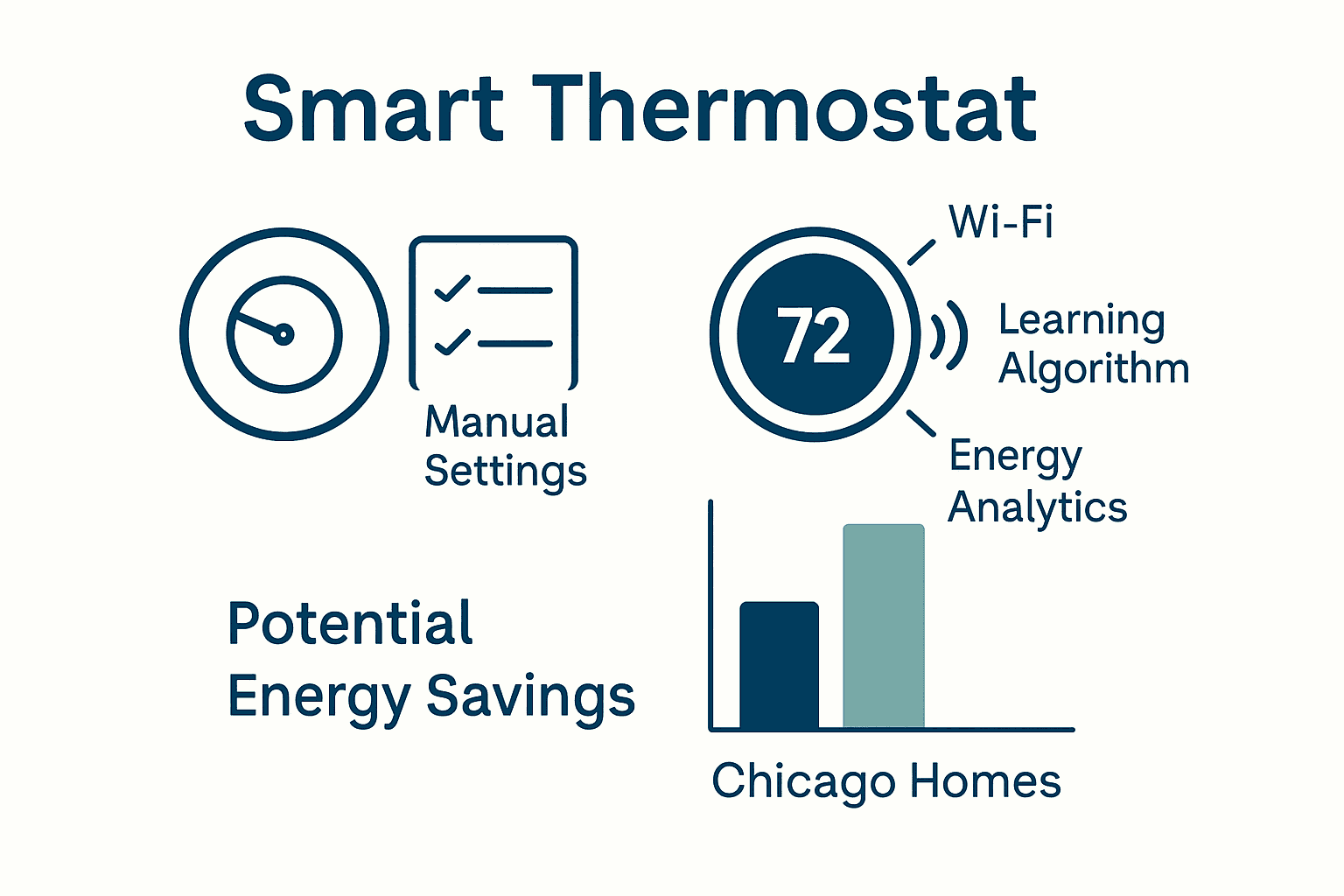
Here’s a comparison of the key differences between traditional and smart thermostats:
| Feature | Traditional Thermostat | Smart Thermostat |
|---|---|---|
| Programming | Manual, time-consuming | Automated, learns your schedule |
| Energy Efficiency | Limited optimization | Maximized through intelligent features |
| Connectivity | Stand-alone, no network | Wi-Fi, app, and remote access |
| Learning Capability | None | Adapts to usage patterns |
| Reporting | No energy data | Detailed energy consumption reports |
| Smart Home Integration | Not supported | Seamless with other smart devices |
Practical Considerations for Chicago Area Homes
ENERGY STAR recognizes that regions like Chicago demand special considerations when selecting smart thermostats, given the city’s extreme temperature fluctuations ranging from brutal winter freezes to humid summer heat. The right smart thermostat must be robust enough to handle dramatic seasonal shifts while maintaining optimal energy efficiency for local homeowners.
Key practical considerations for Chicago homes include:
- HVAC System Compatibility: Ensuring the smart thermostat works with existing heating and cooling infrastructure
- Temperature Range Tolerance: Selecting devices capable of handling -10°F to 95°F effectively
- Connectivity Reliability: Maintaining performance during severe weather conditions
- Insulation Interaction: Complementing home’s existing thermal management systems
According to BASC, for Chicago area homes, selecting a smart thermostat compatible with existing HVAC systems is crucial for optimal performance. This becomes especially important given the city’s unique climate challenges. How Chicago Weather Damages Homes & What to Inspect highlights how extreme temperature variations can stress home systems, making a resilient smart thermostat an essential investment.
Chicago homeowners should prioritize smart thermostats with advanced weather adaptation features. These devices can automatically adjust heating and cooling based on real-time local conditions, whether you’re in a Lincoln Park brownstone or a suburban Evanston home. The ideal smart thermostat for a Chicago residence will offer robust Wi-Fi connectivity, comprehensive energy reporting, and the ability to learn and optimize your specific household’s temperature preferences across wildly different seasonal conditions.
Take Control of Your Home Comfort with Expert Guidance
The article highlights how smart thermostats can transform your home climate by learning your schedule, optimizing energy use, and offering remote control. However, understanding your home’s unique heating and cooling system is essential to unlock all these benefits. Many Chicago homeowners face challenges like HVAC compatibility and extreme weather conditions that impact the performance of smart thermostats and your energy savings.
Our comprehensive Home Inspection Services are designed to identify these exact challenges. We help you understand your existing systems, ensuring your smart thermostat investment delivers the comfort and efficiency you deserve. Don’t let uncertainty about your home’s condition prevent you from saving on utility bills or enjoying the convenience of smart climate control.
Ready to maximize your home’s energy efficiency and comfort? Schedule a detailed inspection with our licensed and certified professionals today. Visit Schedule Your Inspection and take the first step toward a smarter, more comfortable home.
Frequently Asked Questions
What are smart thermostats?
Smart thermostats are Wi-Fi-enabled devices that manage heating and cooling in homes automatically, allowing remote control and learning user preferences for optimal energy efficiency and comfort.
How do smart thermostats save energy?
Smart thermostats save energy by automatically adjusting heating and cooling based on occupancy patterns, local weather data, and user schedules, which reduces unnecessary energy consumption.
What features should I look for in a smart thermostat?
When choosing a smart thermostat, look for features such as HVAC system compatibility, learning capabilities, remote management through apps, occupancy sensors, and detailed energy consumption reports.
How do smart thermostats differ from traditional models?
Smart thermostats differ from traditional models primarily in their ability to learn user behaviors, optimize energy usage automatically, connect to home networks, and provide detailed reporting on energy consumption.