
TL;DR: No, you do not need to be at your Chicago home inspection, and the report you get the next business day is written for people who were not there. If you can make it, come for the last 30 to 45 minutes, when we walk you through the summary items in the rooms where they are.
Do I have to be there?
No. Nothing in Illinois law or the standard contract requires the buyer to attend. The Multi-Board Residential Real Estate Contract 8.0 (Paragraph 15) gives you the right to have the property inspected; it does not say you have to watch. The Illinois Standards of Practice (68 Ill. Adm. Code 1410.200) require the inspector to deliver a written report, and our report is the same whether you stood next to us or read it on your phone from another state.
What attendance changes is how quickly the findings make sense to you, and that is worth something when the contract clock is short.
When during the inspection should I show up?
The last 30 to 45 minutes. A full inspection of a Chicago house runs about three hours, and the first two are spent on the roof, around the exterior, in the attic and in the basement with a flashlight and a moisture meter. That is head-down work. We move faster and miss less when we are not narrating it, and there is nothing for you to see on a roof from the sidewalk anyway.
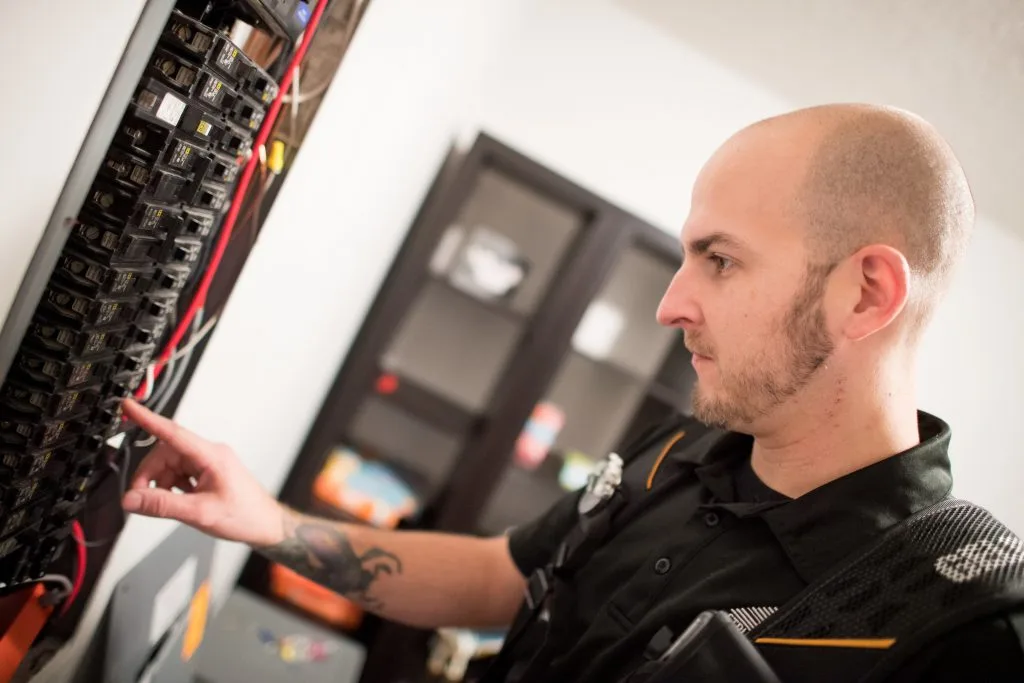
By the last half hour the findings are in the software and we know which ones will be in the summary. That is when a walkthrough is useful: we take you to the electrical panel, the furnace, the water heater, the basement wall with the crack, and the bathroom with the loose toilet, and show you each one in place. Fifteen minutes in front of a defect explains more than three paragraphs about it.
If you would rather be there for all of it, you are welcome. Bring a notebook and plan to stay out of the attic and off the roof. Our post on how long a home inspection takes shows the order we work in, so you can time your arrival.
What do I actually gain by being there?
You learn where things are
The main water shutoff, the gas meter valve, the electrical panel and which breaker feeds what, the furnace filter slot, the sump pump and its discharge, the exterior hose bib shutoffs. In a River North condo we inspected this September the main water shutoff was not inside the unit at all, and the buyer needed to confirm its location with building management before closing. That is an easier conversation to have while you are standing in the utility closet.
You see the difference between a defect and a maintenance item
In print, “combustible gas detected at the range flex connector” and “range not secured with an anti-tip bracket” are both one line. In the kitchen, one of them is us holding a detector at a fitting and watching it alarm, and the other is us pulling the front of the range forward an inch. We found both in each unit of a two-flat on the Northwest Side this July. Seeing them sorts your priorities for you.
You get to ask the question that is not in the report
“Which of these would you fix first?” “Is this the kind of crack you would walk away from?” “Does the furnace have a few winters left?” A report describes conditions. Those questions get an inspector’s judgement, and they are the ones buyers ask most at the end of the walkthrough.
What if I cannot attend?
Relocating buyers, buyers with a job that does not allow a weekday morning off, and investors buying two-flats they have walked once all ask this. Here is what happens.
- The report arrives the next business day. Every finding has a location, a photo (often several, with an arrow on the thing we mean), what it is, why it matters, and what we recommend. Look at a sample report to see the format before you book.
- The summary comes first. Safety items and major-system defects are pulled to the top so you and your attorney can work from one page during the contingency period.
- We walk you through it by phone. Once you have read the summary, we schedule a call and go through the findings in order, the same walkthrough we would have done in the house. Have the report open and ask the same questions you would have asked in person.
- Your agent can attend in your place. Many do, and a good one will text you photos of anything we point out during the day.
The one thing you lose by not being there is the walkthrough of shutoffs and controls. Ask us to photograph the main water valve, the gas valve and the panel directory, and we will put them in the report so you have them on move-in day.
What does my agent typically do on inspection day?
In Chicago the buyer’s agent usually arranges access through the listing side, either a lockbox code or a showing window, and either lets us in and leaves or stays for the walkthrough with you. The listing agent is sometimes present at the start, rarely for the whole inspection. Neither agent needs to follow us around, and we do not need them to.
What we do need from the agent is the practical list: the access code, whether there are pets, whether any area is off limits, and whether the utilities are confirmed on. Our page for agents covers how we work with the buyer’s side, and our post on what Chicago Realtors should expect on inspection day is written for them.
What is different about an Illinois inspection day?
- The seller is normally not there. Occupied houses are vacated for the inspection window. If a seller stays, that is unusual, and it is fine for you to speak to them, but keep repair conversations for the attorneys.
- Utilities must be on. Paragraph 15 b) of the Multi-Board 8.0 contract has the seller agreeing “to make all areas of the Real Estate accessible for inspection(s) upon reasonable notice and to have all utilities turned on during the time of such inspections.” A furnace we cannot run or a water heater with the gas off is a limitation in the report, and it costs you a finding. If the house is vacant or winterized, read our post on inspecting a home with the utilities off before the appointment, not after.
- Access to the attic, the panel and the furnace. The same paragraph covers this. The attic hatch in a closet stacked with boxes, a panel behind a bookshelf, a furnace closet used as storage: ask the listing side to clear them the day before. We do not move the seller’s belongings, and the Standards of Practice do not require us to.
- Condos. The unit is in scope; the roof, the common risers and the building’s mechanicals are the association’s. For a condo, attendance matters less and the association documents matter more. See our condo inspection page for what is and is not covered.
- Radon runs after we leave. If you add a radon test, the monitor stays in the house for at least 48 hours and we come back for it. Nobody needs to attend the pickup.
What can I check myself, before or during?
Whether you come for the last half hour or come at all, there are five things any buyer can look at during a showing or the final walkthrough that tell you a lot about how the house was kept.
- Press the test button on a GFCI outlet. Kitchen counter, bathroom, garage, exterior. It should click and kill the power; reset should bring it back. In a pre-1980 Chicago kitchen or bath, there may be no GFCI at all, and that will be in our report. Our post on what a GFCI is and why it matters explains the finding.
- Open the cabinet under each sink. Run the water for a couple of minutes and look at the trap and the supply valves with a phone light. A swollen cabinet floor or a ring stain means a leak someone lived with.
- Open and close a few windows. Old wood double-hungs with broken sash cords will not stay up. Painted-shut sashes in a bedroom are an egress problem, not a cosmetic one.
- Walk the outside after rain if you can. Downspouts that end at the foundation, grade that slopes toward the house, and a wet gangway are the usual causes of the basement stains we find inside.
- Find the attic hatch. Just knowing where it is tells us whether we can get in, and a hatch with a fresh bead of paint sealing it shut is worth a question.
None of this replaces the inspection, and none of it is a reason to skip one. It is how you arrive knowing what to ask. If you are still before the offer stage, our post on pre-offer walk-throughs covers the short version of what we look at when there is no contract yet.
What should you do next?
Book the inspection for the earliest slot the seller can give access, because the Multi-Board 8.0 contingency clock is five business days from acceptance and the report needs a business day after the visit. You can book online with real-time availability and the price on screen; weekend appointments are available. Then decide whether you will be there for the last 45 minutes. If yes, tell us when you book and we will text you when the walkthrough is about to start. If no, plan on a call the day the report lands, with the summary open in front of you.