

TL;DR: An Illinois home inspection covers ten systems named in the state Standards of Practice (68 Ill. Adm. Code 1410.200), and the inspector must visually examine what is readily accessible, operate what turns on with normal controls, and put the results in writing within two business days. Everything else, from radon and mold to the sewer lateral and anything behind drywall, is a separate service, a referral, or out of scope.
What rule actually decides what a Chicago home inspection covers?
Not the inspector’s mood. Every licensed Illinois home inspector works under the Home Inspector License Act, and the scope lives in Subpart C of its rules, Section 1410.200, Standards of Practice. Three definitions there answer nearly every “why didn’t the inspector check that?” question:
- Inspect means “to visually examine readily accessible systems and components,” using normal operating controls and opening readily accessible panels. Visual and non-invasive by definition.
- Readily accessible means available for visual inspection “without requiring moving of personal property, dismantling, destructive measures, or any action that will likely involve risk to persons or property.” Boxes stacked against a basement wall make that wall not readily accessible.
- Representative number means one per room for windows, doors, and receptacles, and one per side of the building for exterior components. The rule does not require every outlet in the house.
The rule also requires a signed pre-inspection agreement listing the systems to be inspected and any exclusions, and a written report within two business days (we deliver the next business day). The report must describe each system, name the items that are “significantly deficient” (defined as unsafe or not functioning), say whether each should be corrected or monitored, and disclose anything present that could not be inspected and why.
One thing the standard does not do is mention Chicago. It is written for the whole state. When a Chicago rule is stricter, we inspect to the Chicago rule and say so. The two that come up most are the 42-inch guardrail height on multi-family porches and balconies, and Chicago’s own electrical code, Title 14E of the Municipal Code.
What is excluded from every Illinois home inspection?
Section 1410.200(d)(8) sets limits that apply to the whole inspection. The inspector is not required to:
- Determine the condition of anything not readily accessible, the service life of any system, or the cause behind a needed replacement.
- Operate any system that is shut down or does not turn on with normal controls. A furnace with the gas valve closed stays closed; the report says so.
- Enter any unsafe area, perform engineering or environmental services, report on future conditions, or offer any warranty or guarantee.
In plain terms, a home inspection is a snapshot of what could be seen and operated on one day, under that day’s weather. It is not a “technically exhaustive” investigation, which the rule defines as one involving dismantling, instruments, calculations, or testing.
System by system, what does the standard require and where does it stop?
Structure and foundation, 1410.200(g)
Required: inspect the foundation and framing; describe the foundation type; report the methods used to inspect the basement or crawl space, attic, and framing; report visible water penetration and condensation; report any infestation that significantly impacts the structure.
Not required: engineering analysis, anything behind finished walls or stored belongings, or a wood-destroying insect report.
In Chicago: older bungalows and two-flats sit on brick or rubble-stone foundations, and the basement is often finished on two or three sides. The report says which walls were visible and what we saw on them: efflorescence, step cracking at the corners, spalled brick at grade. Where the pattern suggests movement rather than age, we recommend a structural engineer.
Exterior, 1410.200(h)
Required: inspect the wall covering, exposed foundation, flashing and trim, exterior doors and windows, attached decks, balconies, stoops, steps, porches and their railings; eaves, soffits, and fascia if readily accessible from the ground; grading, drainage, vegetation, and retaining walls where they affect the building; walkways and driveways leading to entrances.
Not required: fences, lot lines, detached sheds, or anything not reachable from the ground or the roof.
In Chicago: the state rule says “railings” and never names a height. Chicago’s building code does: 42 inches for guardrails on multi-family buildings, porches, and balconies, not the 36 inches you will read on national sites written around the IRC. On a rear wood porch serving a three-flat, that six-inch difference is the finding.
Roofing, 1410.200(i)
Required: inspect the roof covering, drainage systems, flashings, skylights, chimneys, and penetrations; describe the covering and report the method used to inspect the roof.
Not required: walking a roof that is unsafe, predicting how many years it has left, or certifying it leak-free. The rule makes us say how we looked.
In Chicago: many two-flats and condo buildings have flat modified bitumen roofs. We walk them when the access is safe and the membrane is dry. When ice, standing water, or a hatch that opens onto a parapet makes that unsafe, the report states that the roof was inspected from the hatch, from a ladder at the eave, or from an adjacent elevation. On a condo, the roof is a common element the association maintains, so the report notes it as outside the unit scope (see our condo inspection page).
Plumbing, 1410.200(j)
Required: inspect and describe the interior supply and distribution system (fixtures, piping, drains, waste, and vents), water heating equipment, fuel storage and distribution, and sump pumps. Report the location of the main water shutoff, the service entry, the distribution piping material, the water heater type and capacity, and any leaks.
Not required: the underground sewer lateral, water quality, wells, or septic. The sewer scope is a referral to a partner company; read when a sewer scope is worth it in Chicago before deciding. We do not offer well water or septic evaluation.
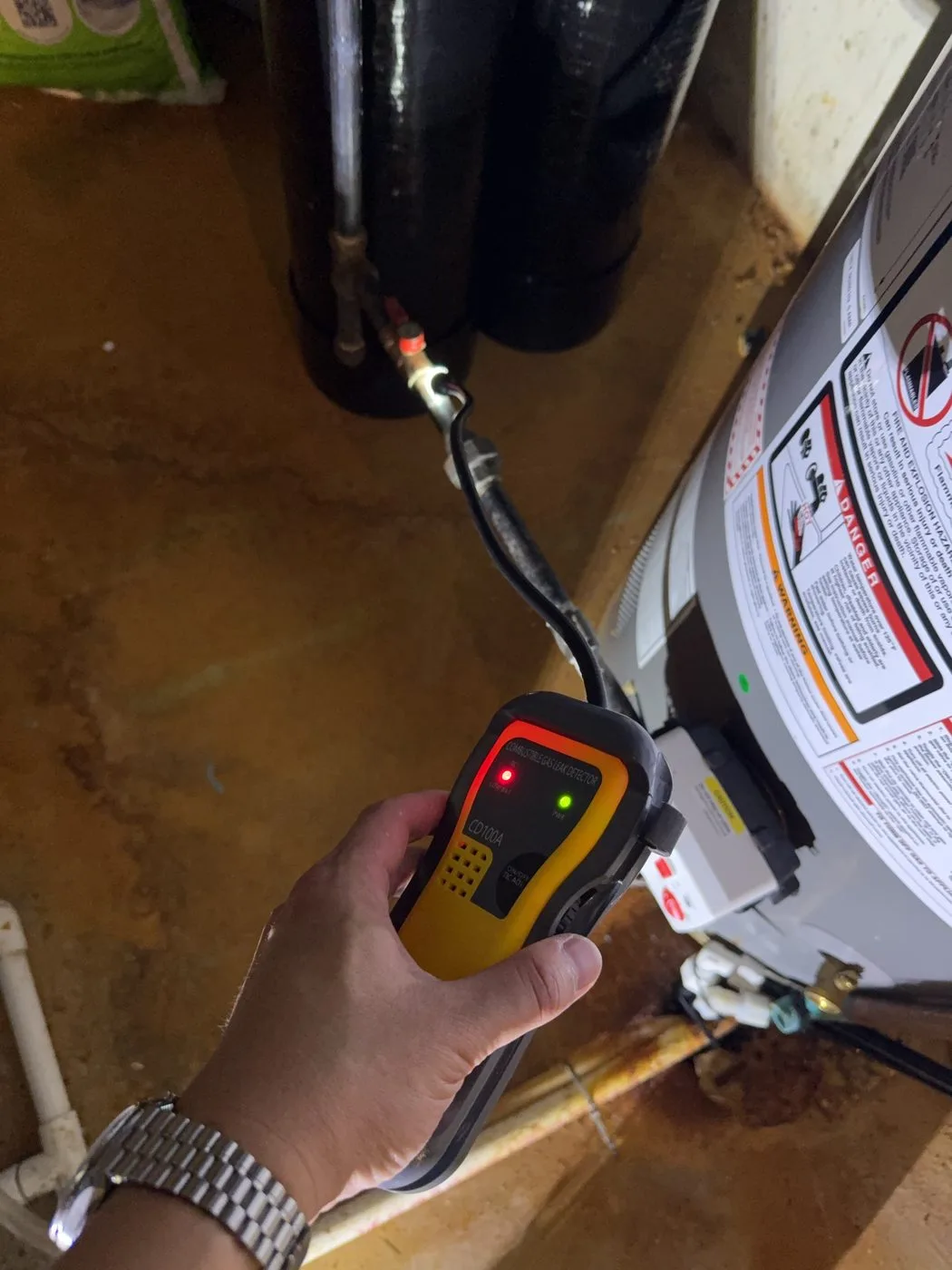
In Chicago: “fuel distribution” means the gas piping, and we use a combustible gas detector at every gas appliance connection. On a Chicago two-flat in July 2026 it read positive at the range flex connector in both the front and rear units, a major concern in each. The main shutoff location is a required report item, and in a River North condo this September it was not inside the unit at all; the report told the buyer to confirm its location with building management before closing.
Electrical, 1410.200(k)
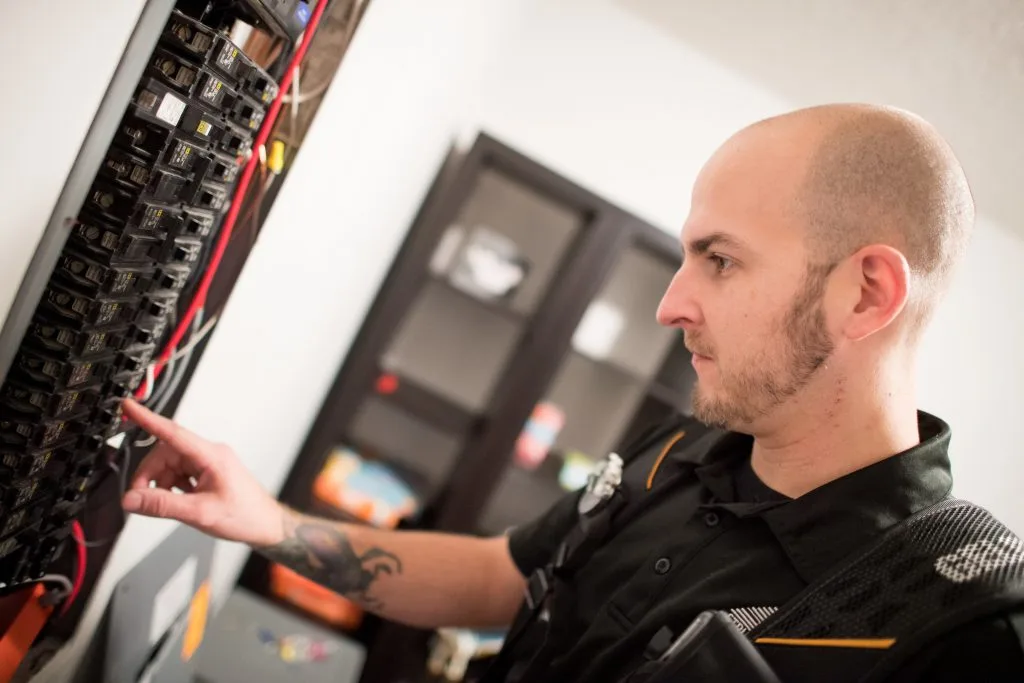
Required: inspect the service drop, entrance conductors and raceways, service equipment and main disconnect, service grounding, the interior of panels and subpanels, conductors, overcurrent devices, a representative number of lights, switches, and receptacles, and GFCIs. Describe the amperage and voltage rating, the location of the main disconnect and subpanels, and the wiring methods. Report solid-conductor aluminum branch wiring, and any non-compliance with the Carbon Monoxide Alarm Detector Act (430 ILCS 135) and the Smoke Detector Act (425 ILCS 60).
Not required: testing every receptacle, tracing circuits, evaluating low-voltage or alarm wiring, or removing anything beyond the panel cover.
In Chicago: Chicago wiring runs in metal conduit under Title 14E, and that conduit is the equipment ground. A 1920s two-flat with cloth-covered two-conductor wire inside EMT is not “ungrounded,” and we test the receptacle for a ground path rather than assuming the worst from the wire’s age. Title 14E also keeps the rule (14E-2-240) that a panel cannot be in a clothes closet. The alarm laws are concrete: a CO alarm within 15 feet of every sleeping room, and any battery-only smoke alarm installed since January 1, 2023 must have a sealed 10-year battery. On the two-flat above, a panel hand-labelled “Public” listed bedroom, kitchen, and laundry circuits in its directory, and that went in the report. If aluminum branch wiring turns up, here is what it means for a Chicago buyer.
Heating, 1410.200(l)
Required: inspect the permanently installed heating equipment, including fans, pumps, ducts, piping, controls, supports, registers, and radiators, and the visible vents, flues, and chimneys. Describe the energy source, the equipment, and the heating method.
Not required: the heat exchanger (that takes dismantling), firing equipment that is shut down, measuring efficiency, or predicting remaining life.
In Chicago: the venting is where the defects hide. Each fall we find rust staining on burner compartments and vent connectors from condensation draining back into the cabinet, vent connectors held by fewer than three screws per joint, gas piping through the furnace cabinet with no bushing at the penetration, and white plumbing PTFE tape on gas joints where yellow gas-rated tape belongs. What we do not call a defect: a single-pipe Category IV high-efficiency furnace in a closet with louvered doors. The louvers are the combustion air path.
Cooling, 1410.200(m)
Required: inspect the permanently installed central and through-wall cooling equipment and its controls; describe the energy source and cooling method. Not required: measuring refrigerant charge, opening the sealed system, or running equipment when doing so could damage it.
In Chicago: the calendar decides this one. When the outdoor temperature has been too low for the manufacturer to allow the compressor to run, we do not start it. The report says the system was not operated and why, and it still describes the condenser, its age, and its condition.
Interiors, 1410.200(n)
Required: inspect walls, ceilings, and floors; steps, stairways, balconies and their railings; countertops, installed cabinets, and household appliances included with the property; doors and windows; garage doors and operators. Report visible water or moisture penetration.
Not required: cosmetic conditions (paint, carpet stains, worn trim), moving furniture or rugs, or anything decorative.
In Chicago: the appliance clause catches two things buyers never think about. First, the range anti-tip bracket: on the same two-flat in July, neither unit’s range was fastened, and a free-standing range with the oven door open will tip forward under a child’s weight. Second, windows. In September 2026 we found bedroom windows set low to the floor and more than 72 inches above exterior grade with no opening limiting device, and recommended a 4-inch restriction.
Insulation and ventilation, 1410.200(o)
Required: inspect insulation and vapor retarders in unfinished spaces, ventilation of attics and foundation areas, and mechanical ventilation in attics, kitchens, bathrooms, and laundry rooms. Describe the insulation and note where it is absent at conditioned surfaces. Not required: verifying R-value, disturbing insulation, or entering an attic with no safe access.
In Chicago: bungalow attics are reached through a closet hatch or a knee-wall door, and the report says whether we entered or viewed from the hatch. The common findings are bath fans that terminate in the attic instead of outdoors and, in condos, a bathroom fan that does not reach the vaulted part of the ceiling.
Fireplaces and solid-fuel appliances, 1410.200(p)
Required: inspect the system components, vents, flues, and chimneys; describe them and report visible significant damage or deterioration. Not required: a camera scan of the flue, a draft test, or lighting a fire. When we cannot see the full flue of a used masonry fireplace, we recommend a sweep’s camera inspection before the first fire.
In Chicago: gas fireplaces in condo bedrooms pull the CO alarm law back in. One unit we inspected this year had no smoke or CO alarms at all, including the room with the gas fireplace, and that is reported under the Carbon Monoxide Alarm Detector Act, not as a fireplace note.
What is never part of the standard inspection, even in Chicago?
Items people assume are included. Some we do as separate services, some we refer out.
- Radon testing. A separate service we do in-house under an IEMA measurement license. The monitor is set at the inspection and collected after the required test period, so book it with the inspection, not after.
- Mold sampling. Also in-house and also separate. The home inspection reports visible staining and suspected growth; sampling tells you what it is and what is in the air.
- Sewer scope. A referral to a partner company, scheduled for the same visit when possible. Clay laterals under Chicago parkways are exactly why.
- Termite and pest inspection. The standard requires reporting structurally significant infestation, not a wood-destroying insect report for your lender.
- Lead paint and asbestos testing. Environmental services, excluded by 1410.200(d)(8)(C). We identify suspect materials and stop there.
- Code certification, appraisal, or permit history. We cite code where it explains a finding. We do not certify a house as compliant or opine on whether past work was permitted.
- Condo common elements. The roof, the basement boiler, the parking structure. A unit inspection stops at the unit and the systems serving it.
Which type of inspection do you need?
The Standards of Practice describe one inspection. What changes is who orders it, when, and what you do with the report.
| Type | Who orders it and when | What is different |
|---|---|---|
| Pre-purchase | The buyer, inside the contract’s inspection period | The full SOP inspection. Findings feed the attorney review negotiation. Start with our pre-purchase workflow. |
| Pre-listing | The seller, before photos and the first showing | Same scope, but you control the repair timeline and the disclosure. See the pre-listing guide. |
| Repair verification | The buyer, after the seller says the negotiated repairs are done | A follow-up visit limited to the repair list. Each original observation is restated with what was found; not a second full inspection. |
| 11-month warranty | The owner of a new build, before the builder’s one-year warranty expires | Full SOP scope after one heating and one cooling season. See what goes wrong in Chicago new construction. |
| Information-only | A current owner, no transaction pending | Same scope, no negotiation. A maintenance baseline, a pre-renovation record, or a buyout between co-owners. |
Whichever you choose, the license number on the agreement and the report is the check that matters. Illinois requires it on both, and the state issues it. Association certifications are training credentials, not a substitute.
What should you do with the report?
Read the significantly deficient items first. The rule requires each to say why it is deficient and whether it should be corrected or monitored, and that split is your list: corrected items go to your attorney during the review period, monitored items go on your maintenance calendar. Then read the disclosures of what could not be inspected; those are the questions still open before closing, answered by clearing the access or ordering the specialist inspection the report recommends.
To see what that looks like on a real Chicago property before you book, our sample report is a complete report from a real inspection, with the correct-or-monitor language the rule requires. If your inspection period is already running, the booking page shows real-time availability and the price on screen, weekends included, so you can lock a date without a phone call. Agents coordinating for a client can start at the agent page. And if the report comes back with more than you expected, here is how Chicago buyers handle it.