

TL;DR: Chicago houses fail on a schedule: furnaces in the first cold week, hose bibs at the thaw, sump pumps in the May rains, gas connections whenever nobody has checked them. This calendar lists what to do in each stretch of the year and what we actually find when we inspect in that season, so you know which jobs to do yourself, which trade to call, and when a maintenance inspection is the better move.
Most maintenance checklists are written for a generic house in a generic climate. This one follows the Chicago year as we see it from the basement, the attic and the roof edge: five blocks of months, a short list for each, then the defects that keep showing up in reports written during that block.
October to November: what should I do before the first furnace run?
Heating season starts on the first night below 40°F, and a furnace idle since April gets asked to run at full fire with no warm-up. Do this block early in October.
- Run the furnace through a full cycle on a mild day and stay with it. Look at the burner compartment and the vent connector for orange staining or water tracks.
- Count the screws at every joint of a single-wall vent connector. Three per joint is the standard, and the pipe should rise continuously toward the chimney with no level or sagging run.
- Put in a new filter and confirm the filter slot has its cover. A 1-inch filter lasts one to three months; a 4- or 5-inch media filter, six to twelve.
- Book furnace service if the unit is past ten years or has not been serviced in two. September and early October are the quiet weeks for HVAC contractors.
- Disconnect hoses, close the interior shutoff to each outdoor faucet, then open the outside faucet and leave it open so the line drains.
- Clean gutters after the leaves are down, usually mid-November, and extend downspouts at least five feet from the foundation.
- Have a wood-burning flue swept, and replace failed exterior caulk and weatherstripping while sealant can still cure. Our window and door seal guide covers what to look for.
What we actually find when we inspect in the fall
The first week furnaces run again is the most productive week of the year for us. Rust staining on the burner deck and at the vent connector joints shows up on furnaces that looked fine in August, because condensation drained back into the cabinet while the unit sat idle. Vent connectors held with one or two screws per joint, or none, are routine, and so are filter compartments with no cover. On natural-draft water heaters we put a level on the single-wall connector and regularly read dead level: no rise to the chimney, and a flue that spills on a cold start. We also find relief valves with no discharge pipe, cardboard stacked against a furnace cabinet inside a closet, and downspouts that discharge onto a lower roof instead of into a gutter.
December to February: what do I check once the house is sealed up?
Winter is when the house is closed, the gas appliances run hardest, and the attic shows what the insulation and ventilation are really doing. It is also the season the two Illinois alarm statutes were written for.
The Illinois Smoke Detector Act (425 ILCS 60) requires a working smoke alarm within 15 feet of every room used for sleeping and on every story including the basement. Since January 1, 2023, any new battery alarm must have a 10-year sealed, non-removable battery; hardwired and wireless-interconnected systems are exempt from that rule. Alarms installed before 2023 can stay until they are 10 years past the manufacture date printed on the back, or until they fail a test. The Carbon Monoxide Alarm Detector Act (430 ILCS 135) requires at least one CO alarm in operating condition within 15 feet of every room used for sleeping. A CO alarm on the basement wall beside the furnace does not satisfy that; it belongs in the hallway outside the bedrooms.
- Walk every floor and confirm a smoke alarm on each level and a CO alarm within 15 feet of each bedroom door. Anything past 10 years from its manufacture date gets a sealed-battery replacement.
- After the first snow that sits for a few days, look at the roof from the street. Bare stripes over the rafters, or a bare patch over the bathroom, mean heat is escaping into the attic. That is the start of an ice dam; our ice dam guide explains what to do.
- Go into the attic on a cold morning. Frost on the underside of the sheathing, rusty nail tips, and a bath fan duct that ends in the insulation are ventilation problems. Insulation should meet R-49, but air-seal the attic floor before adding any; see attic ventilation for Chicago homes.
- Rake snow back at least 3 feet from the eaves after a storm of 6 inches or more. Never put salt or calcium chloride on a roof or in gutters.
- Hold indoor relative humidity between 30 and 50 percent. Condensation inside double-pane windows in January means you are above that, and the attic is probably wet too.
- Below 10°F, open the cabinet doors under sinks on exterior walls and let a faucet on the far side of the house drip.
- Within a day of any storm, clear snow from the furnace and water heater intake and exhaust terminations and from the dryer vent. A blocked termination shuts a high-efficiency furnace down; a blocked natural-draft flue is worse.
- Change a 1-inch filter monthly while the furnace runs daily, and check the basement walls for new dampness or efflorescence during the January thaw.
What we actually find when we inspect in winter
Missing alarms are the most common winter safety finding we write, and not only in old houses. In condo units we have found no smoke or CO alarm anywhere in the unit, including the room with the gas fireplace. In the attic, winter is the only season the evidence is fresh: frost on the sheathing, melt stains still wet, bath fans exhausting into the insulation. From the street the ice dam is already forming at the eave above whichever room has the recessed lights. Our winter maintenance list goes deeper on cold-weather tasks.
March to April: what did winter break?
Spring does not damage the house. Winter did, and the thaw is when it shows. Frozen ground held cracked concrete in place, snow hid the gutters that pulled off the fascia, and the outdoor faucet that froze in January has not leaked yet because nobody has turned it on.
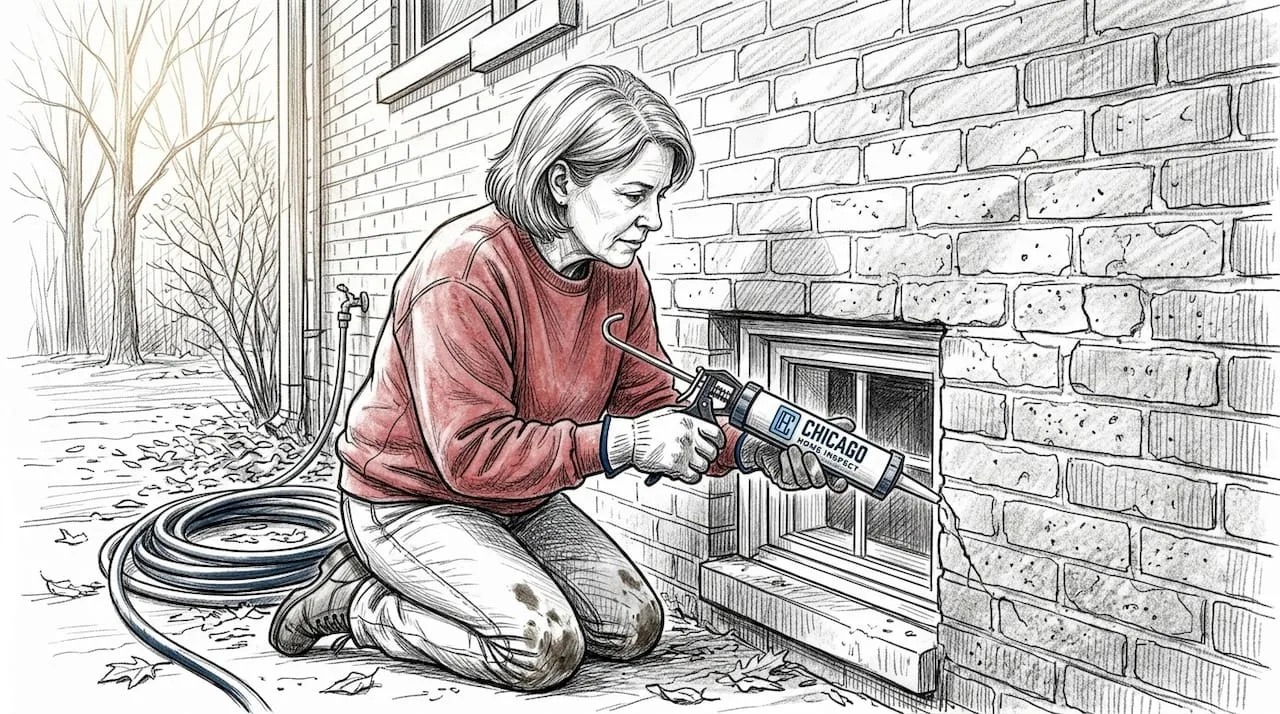
- Open the interior shutoff to each outdoor faucet, then have someone open the faucet outside while you watch the pipe and the ceiling below it for a full minute. A frost-free faucet that froze splits inside the wall and only leaks with the water on and the handle open.
- After the first hard rain, go into the attic with a flashlight and look for fresh dark spots on the sheathing and wet insulation. That is the earliest warning of an ice dam leak or a flashing failure.
- Check the roof line from the ground with binoculars: lifted shingles, flashing pulled at the chimney, gutters sagging or separated at the downspout. Our guide to spotting hail and wind roof damage shows what each looks like. A pile of granules at the downspout outlet means the roof is shedding its surface.
- Walk the foundation. Soil should slope away from the house; fill low spots and gaps where soil has pulled back from the wall. Any new crack wider than a quarter inch, and any horizontal crack in a foundation wall, gets a professional look.
- Check basement walls for efflorescence and the floor for staining, and read our guide to signs of moisture intrusion before deciding it is nothing.
- Do not run the air conditioner until outdoor temperatures are reliably above 60°F; our AC and furnace age guide explains what to check first.
What we actually find when we inspect in spring
Failed outdoor faucets lead the list. We turn the water on, open the hose bib, and water appears on the basement ceiling below it or runs down the inside of the rim joist. Nobody knew, because nobody had used it since October. We find downspouts disconnected from the underground drain tile so they dump beside the foundation, sump pits with no cover or an unsealed one, and missing kick-out flashing where a roof meets a sidewall, with a ceiling stain inside that the owner calls an old leak. On flat-roofed two-flats the parapet walls and coping are where winter damage shows first.
May to June: what do I check before the May rains and the first heat?
Chicago’s heaviest rain arrives in May and June, and much of the city is on a combined sewer. The sump pump, the backwater valve and the supply lines inside the house get tested in this block, before the storm tests them for you.
- Pour a bucket of water into the sump pit and watch the pump start, run and stop. Confirm the check valve holds, and follow the discharge line outside to make sure it ends well away from the foundation. What a sump pump failure costs in Chicago covers battery backups and replacement intervals.
- If the house has a backwater valve on the sewer line, open the access cover and confirm the flapper moves freely and the seat is clear. If you cannot find one and the basement has a floor drain, that is worth knowing before the next backup.
- Put a leak alarm on the floor at the washing machine, the water heater and under the kitchen sink. They are inexpensive, battery powered and the best purchase on this list.
- Find the date you installed the braided stainless supply lines at the toilets, faucets, dishwasher and washer. Past five years, replace them. If you do not know the date, replace them.
- Have the air conditioner serviced in May, and disconnect the dryer duct and clear it end to end, replacing foil or plastic flex with rigid metal.
- Press the test button on every GFCI, outdoors included. Our GFCI guide explains which locations need them.
- Trim branches back at least 10 feet from the roof, and set the dehumidifier to hold the basement between 30 and 50 percent.
What we actually find when we inspect in late spring
Water detection is the gap. In houses and condo units alike we write “no water detection alarm at the furnace or laundry” far more often than the opposite, and in a condo the neighbour below pays for it. Braided supply lines well past the five-year window are the norm, and we have traced an active leak under a kitchen sink to the braided dishwasher line. Sump pumps with no check valve, discharge dumping against the foundation, or an unsealed pit cover in a basement that also has an open slab penetration come up on most spring reports. In River North and similar high-rise units the main water shutoff is often not inside the unit at all, which is something to confirm with building management before you need it.
July to September: what needs attention in storm and heat season?
Summer is roof season, water heater season and the right time for gas appliances, because a leak found in July is fixed on your schedule rather than during the first cold snap.
- After each hail or wind storm, look at the roof from the ground and check the attic for fresh staining. Our roof flashing guide covers the joints that fail first.
- Flush the water heater: gas to pilot or breaker off, hose on the drain valve, a hot tap open upstairs, drain until clear. Lift the temperature and pressure relief lever for a second and confirm it reseats. The relief valve must have a discharge pipe run down to within a few inches of the floor.
- Check every gas appliance connection: range, dryer, water heater, furnace. Look for a flexible connector that is kinked, corroded or passing through a cabinet wall with no bushing, and for white plumber’s PTFE tape on a gas joint where yellow gas-rated tape belongs. If you smell gas, leave the house and call the gas utility from outside.
- Confirm the range has its anti-tip bracket engaged: pull it forward an inch and see if the rear foot catches.
- Repaint and recaulk exterior wood trim, sills and thresholds before fall. Soft wood at a sill is a moisture finding, not a paint finding.
- If drains are slow in more than one fixture, or the house is past 50 years and the line has never been scoped, read when a sewer scope is worth it. We refer scopes to a partner rather than doing them in-house.
- Book fall furnace service in September, and book a maintenance inspection before the leaves cover the roof and the ground freezes.
What we actually find when we inspect in summer
We carry a combustible gas detector and use it at every gas appliance, not just when something smells. In a Chicago two-flat in July 2026 it responded at the range flex connector in both the front and rear units, and both ranges were missing an anti-tip device. We have had it respond at a water heater connection and at the gas meter in the same house, which is a case for one utility check of the whole system rather than two point repairs. Gas piping through a furnace cabinet with no bushing, and white PTFE tape on gas joints, are ordinary findings. On the plumbing side the summer list is dominated by relief valves with no discharge pipe and water heaters past their expected service life that still work, which is exactly when to plan the replacement.
Who do I call: a trade, or an inspection?
A contractor fixes the thing you already know is broken. A maintenance inspection finds the things you do not know about yet and puts them in priority order.
| What you are seeing | Call this trade | Book a maintenance inspection when |
|---|---|---|
| No heat, short cycling, furnace will not stay lit | HVAC contractor | You want furnace, water heater, venting and combustion air judged together before paying for a repair |
| Gas odour, or a CO alarm sounding | Leave the house, then the gas utility or 911 from outside | Afterward, to have every gas connection checked with a combustible gas detector |
| Sump pump dead, or water on the basement floor | Plumber or waterproofing contractor | Dampness with no obvious source, so grading, gutters, foundation and pit are assessed as one system |
| Slow drains in more than one fixture, or a floor drain backup | Sewer scope (we refer to a partner) | The scope is clear and the problem persists |
| Breaker that keeps tripping, warm cover plate, scorched receptacle | Licensed electrician | Nobody has opened the panel in years, or you are about to buy or list |
| Ceiling stain after a storm | Roofer, if the roof is the known source | The source is unknown: roof, flashing, plumbing vent, condensation or a bath fan |
| Nothing is wrong that you know of | Nobody yet | Once a year, so the report becomes the maintenance record |
Is a yearly maintenance inspection worth booking?
A maintenance inspection is the same visual, non-invasive inspection we do for a buyer, performed for the person who already owns the house. A buyer’s report informs a purchase decision. A maintenance report tells you what to fix this year, what to budget for next year and what to monitor, with a photo of each finding.
It covers the roof, flashing and penetrations; gutters and grading; cladding and caulking; the attic for insulation depth, ventilation and moisture; the furnace, air conditioner and water heater including venting and age; visible plumbing and every gas connection; the electrical panel with the dead front off; the basement, sump pit and any backwater valve; and the safety items above. We bring a moisture meter, an infrared camera and a combustible gas detector, and we open the attic hatch and the panel rather than reporting what could be seen from the doorway. Radon measurement and mold sampling are done in-house and can be added to the same visit.
The best time to book is late summer or early fall: the roof is walkable, the grading is visible, and you have weeks to act before the ground freezes. The report arrives the next business day. See how findings are written and photographed in our sample report, then book online with real-time availability and the price on screen before you commit, which most inspection companies still do not offer. Weekend appointments are available. For a condo, the scope is the unit and its systems rather than the building’s common elements; our condo inspection page explains what that includes.
FAQ
How do I know if a smoke or CO alarm is too old?
Turn it over. The manufacture date is printed on the back. Smoke alarms are replaced at 10 years from that date under the Illinois Smoke Detector Act, whether or not they still chirp when tested. CO alarms carry the manufacturer’s own end-of-life date on the label. Test both monthly with the test button.
Can I flush the water heater myself?
Yes, with one warning. A plastic drain valve that has not been opened in years may not reseal once you close it. Have a bucket, a hose cap and the willingness to replace the valve before you start. If the tank is past 12 years and has never been flushed, plan the replacement instead of disturbing it.
Recommended
- Winter Home Maintenance List to Prevent Damage in Chicago | Chicago Home Inspect LLC
- Keep a Healthy Home
- Understanding Home Insurance: Checklist and Key Concepts
- 7 Essential Building Inspection Types Explained Clearly
- Essential Boiler Maintenance Checklist
- Travertine Decor Workflow
- Brick Spalling: What Causes It and How to Fix It in Chicago’s Climate
- Leak Detection Explained
- Essential Home Maintenance Checklist
- Why Inspect Gutters Annually